
Low cost amenities that protect revenue

Amenities are no longer a differentiator. They are a baseline. Across office, retail, industrial, and multi-family portfolios, tenants have a minimum expectation for programming and on-site experience, and it is up to landlords to meet and exceed those demands, according to JLL's 2024 Building Amenities Outlook. For asset managers managing portfolios with lease rollover pressure, the question is no longer whether to invest in amenity programming. It is which programs deliver results without adding operational burden.
This article covers what separates effective amenity programs from expensive ones, and how to choose options that protect NOI without adding new workflows for your property team.
Why amenities affect lease decisions, not just tenant satisfaction
The gap between well-amenitized assets and commodity ones is widening across property types. In office, CBRE's analysis of 4,350 new lease comparables across 12 markets shows effective rents for top-tier buildings rising while lower-tier assets fall. In retail, foot traffic and dwell time correlate directly with on-site programming. In industrial and multi-family, tenant retention is increasingly tied to the quality of shared amenities and recurring touchpoints. The dynamic is the same across asset classes. Tenants compare what they get for their rent. Buildings that give them more reasons to stay win on renewal.
This creates a direct revenue problem for asset managers managing assets without a clear amenity story. If your property does not give tenants a visible, concrete reason to stay, renewal conversations start at a disadvantage.
JLL research shows that by 2025, properties that incorporate a diverse roster of amenities will experience 12% higher demand from tenants versus their plain commodity counterparts. Demand is not built by adding amenity spaces. It is built by activating them.
What vacancy actually costs
Before evaluating program costs, asset managers should price the alternative. A single turnover event is expensive across every asset class.
In office, tenant improvement allowances averaged $92 per sq ft in 2024, down 10% from 2023. Add a free rent period, leasing commissions of 4% to 6% of total lease value, and months of lost base rent, and a single turnover event on a 10,000 sq ft tenant can cost $810,000 to $1,500,000 or more before accounting for carrying costs during the gap. In retail and industrial, the numbers differ but the structure is the same: re-leasing costs, lost income during the gap, and broker fees that compound quickly.
Against those numbers, a tenant engagement program under $10,000 per year is not a perk. It is a retention line item with a clear return.
Four factors that separate effective programs from expensive ones
Not all amenity programs produce the same outcomes. Asset managers evaluating options should hold each program against four practical filters.
Scalability. Does the program work the same way at one building and at ten? Standardized delivery matters when you are managing a portfolio. Programs that rely on local vendor relationships or bespoke event formats do not replicate well.
Minimal lift on the property team. The vendor should handle everything. If your property managers are sourcing speakers, managing RSVPs, or coordinating setup, the program is adding operational load, not removing it. That cost rarely shows up in the vendor invoice but it shows up in staff time and inconsistency.
Measurability. Programs that generate participation data, attendance records, or sustainability reporting outputs give asset managers something concrete to show investors and tenants. Programs that do not generate data do not help with GRESB submissions, LEED documentation, or investor disclosure packages.
Year-round engagement. A one-off event creates one touchpoint. A program with recurring quarterly contact keeps tenants connected to the property across lease cycles. Tenants now expect programming, not just space. A building that offers recurring, activated amenities is harder to leave than one that offers square footage alone, according to JLL. That expectation is not met by an annual rooftop reception.
Programs under $10,000: an honest comparison
Here are seven options asset managers commonly pilot, with a practical read on each.
AmenityEst. costDifferentiatesEngages tenantsSupports leasingNature-based program (e.g., Alvéole)$4,800–$8,400/yrYesYesYesNative pollinator garden$2,000–$7,000YesYesTenant wellness event series$1,500–$5,000/quarterYesYesTenant sustainability challenge$2,000–$6,000YesYesEV charging concierge$1,500–$4,000/yrYesYesYesLunch and learn series$1,000–$3,000/sessionYesYesYesLocal chef pop-up$3,000–$8,000/eventYesYesYes
The programs at the top of this list share a common trait: they produce outputs that travel outside the building. A sustainability challenge generates participation data. An EV charging program tracks usage. A nature-based program produces quarterly reports. These outputs serve disclosure requirements and investor conversations. Events that do not generate data serve only the day they run.
One-off formats like the pop-up or the reception are not worth dismissing, but they have a ceiling. They create a single moment of connection. They do not build a reason to renew.
What to watch for when evaluating programs
PM coordination time. Every hour your property team spends booking vendors, chasing confirmations, or managing RSVPs is time taken from core operations. Programs that route all of that through the vendor are worth a meaningful premium over programs that rely on the on-site team.
Repeatability. Ask: can this run without re-procurement every cycle? Programs built around recurring formats with fixed annual schedules are operationally predictable. One-off events are not.
Data output. Before signing a contract, ask what the vendor delivers in writing. Participation rates, event summaries, attendance logs, and sustainability metrics are table stakes for programs that need to justify renewal to ownership groups and investors.
Fit with your tenant mix. A wellness event series works well in a building where tenants already run robust employee programming. A nature-based outdoor program works best where roof or courtyard access exists. Match the format to the asset.
How Alvéole fits this framework
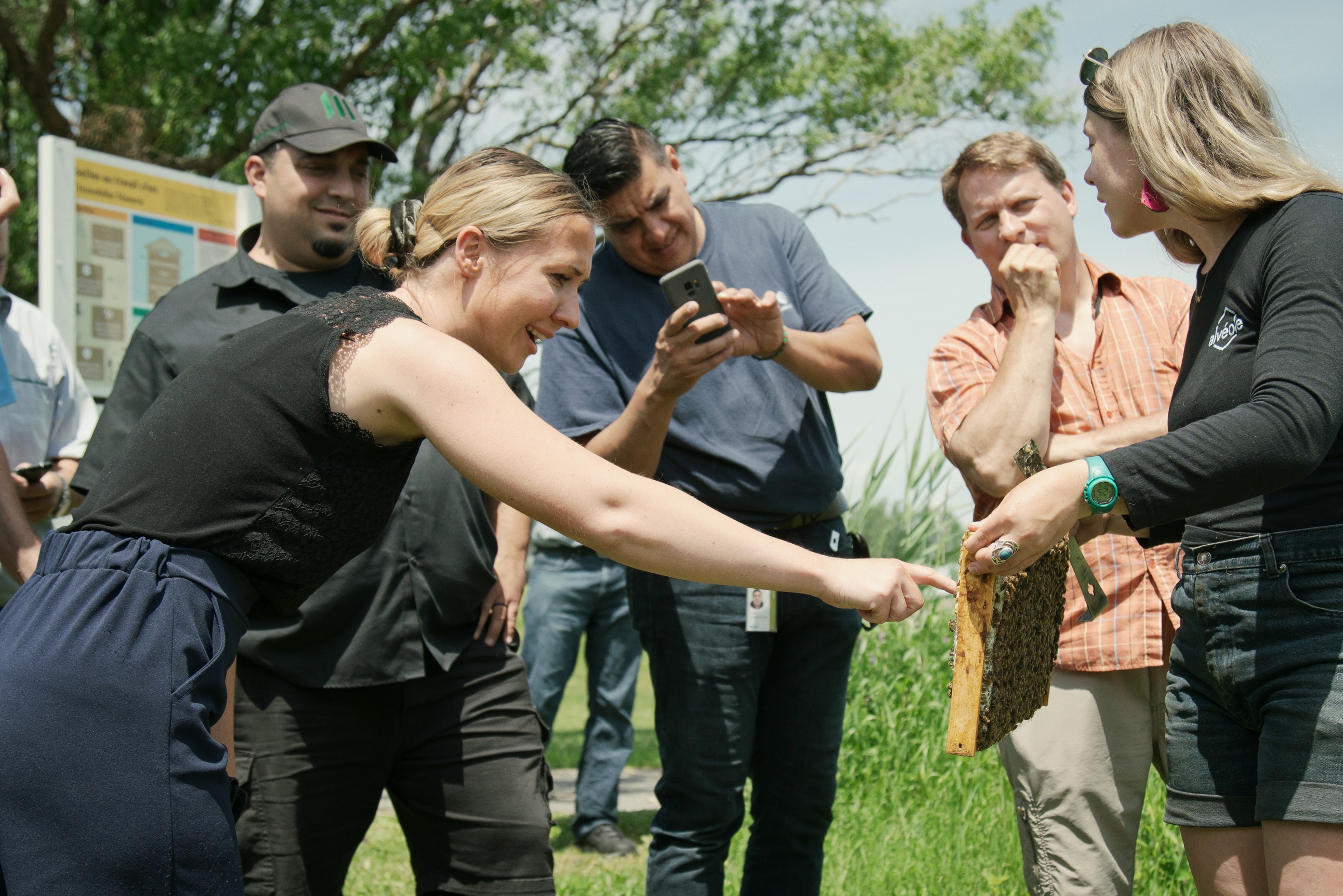
Alvéole installs urban beehives and pollinator habitats as turnkey amenity programs for commercial real estate portfolios across office, retail, industrial, and multi-family assets. The program runs without property management involvement after installation. All logistics, insurance, communications, event coordination, and biodiversity reporting are handled externally.
Asset managers deploy the program in three situations: assets with lease rollover in the next 18 to 36 months, properties competing against newer or better-amenitized inventory for tenant retention, and portfolios that need consistent sustainability reporting data across multiple sites and asset types.
The program produces quarterly touchpoints: hive visits, seasonal events, and harvest programming. Participation data, tenant engagement records, and biodiversity metrics are exportable and formatted for GRESB, BOMA, LEED, and WELL disclosure.
There is no capital commitment. The program starts and stops without sunk costs. The property team receives reports. That is it.
To learn more about how the program runs without adding PM workload, or see how asset managers are using nature-based amenities to lower vacancy, simply book a 15-minute intro call with us.