

The business case for biodiversity: Why investing in biodiversity conservation pays off for buildings
Nature and the economy are closely linked. According to the World Economic Forum, half of the global GDP ($44 trillion of economic value) is highly dependent on nature. This highlights the critical importance of biodiversity conservation for sustaining economic stability.
However, the world is currently experiencing rapid biodiversity loss. Wildlife populations have reduced by 69% since 1970. Another 1 million species are at risk of extinction in the coming decades. Irreplaceable ecosystems are disappearing due to deforestation.
The need to take action is clear. And for industries like real estate, the investment in biodiversity conservation is mutually beneficial.
Let’s dive into why preserving biodiversity is so essential, the real estate industry’s impact on the environment, and the ways real estate can benefit from investing in biodiversity.
WHY BIODIVERSITY IS ESSENTIAL FOR LIMITING CLIMATE CHANGE
According to the UN, the biodiversity and climate crises are inseparable and must be solved together – because the solutions are connected.
Conserving and restoring natural assets, both on land and in the water, is essential for limiting carbon emissions and adapting to a changing climate.
As the world aims to achieve net-zero, nature-based solutions are poised to reduce up to 37% of emissions by restoring, protecting, and managing ecosystems around the world.
The real estate industry has a large impact on land use both within and outside urban environments. But it has not often considered biodiversity conservation or ecosystems as part of its business or climate strategy.
However, restoring and preserving natural systems is a key component to creating resilient and sustainable real estate, while also achieving ambitious net-zero carbon goals.
REAL ESTATE’S IMPACT ON BIODIVERSITY
Real estate plays a significant role in biodiversity loss, particularly through changes in land use and contributions to pollution and climate change.
37% of global carbon emissions are produced by buildings. But green buildings have huge potential to combat climate change through cost-effective energy efficiency measures. And the benefits go both ways.
Here are 3 ways that investing in green building initiatives benefits the real estate industry, as well as the environment.
1. ALIGN WITH POLICIES AND REGULATIONS
Multiple jurisdictions have passed new policies that incorporate biodiversity into planning and financial reporting. Many real estate organizations with biodiversity plans cite getting ahead of the curve in markets with local regulations as a major driver for implementing these biodiversity projects.
Similar to voluntary carbon reduction disclosure frameworks, new frameworks are under development for nature-related risks. This includes the Task Force on Nature-Related Financial Disclosures (TNFD).
The TNFD is a financial market-led management and disclosure framework to report and act on evolving nature-related risks and opportunities. The goal is to help organizations factor nature and biodiversity conservation into financial and business decisions.
As with the Task Force on Climate-Related Financial Disclosures (TCFD), it’s expected that the TNFD’s recommended disclosures will become mandatory in the next few years.

2. EARN GREEN AND HEALTHY BUILDING CERTIFICATIONS
Many nature-positive and biodiversity solutions can help earn green building certifications, such as LEED and WELL, because of their important role in supporting both sustainability and health.
In office settings, access to nature has been shown to:
- Reduce stress
- Improve mental health
- Decrease sick days
- Increase productivity
- Result in higher overall reported employee satisfaction and wellness
READ: 7 tips for incorporating biophilic design in your office
Green building certifications have been proven to increase asset value and marketability. A CBRE analysis of 20,000 U.S. office buildings found that average rent of those with LEED certification is 31% higher than that of non-LEED-certified buildings.
Specific biodiversity-focused building certifications are appearing as well, emphasizing the importance of biodiversity conservation in sustainable development. It’s a safe bet that biodiversity criteria will become more and more common.
Green building certifications
Alvéole’s nature-based solutions can help your building earn points towards many top green building certifications.
READ: Top 7 reasons property managers should obtain green building certifications
3. BENEFIT FROM FINANCIAL GAINS
Making green changes now can lead to greater financial gains in the future.
Natural infrastructure for things like stormwater management and heat mitigation can make your building more resilient and energy efficient. Which means more money in your pocket over time.
Other cost-cutting opportunities include reducing lawn maintenance. Sowing native plant seeds instead of grass is aesthetically pleasing while decreasing maintenance costs.
Nature-based solutions can even increase the value of your property. These kinds of solutions are highly visible to tenants, as well as the broader community, enhancing a company’s brand and marketability.
In addition to attracting more tenants, a CBRE survey determined that 45% of occupiers and investors would pay a premium for a certified green building.
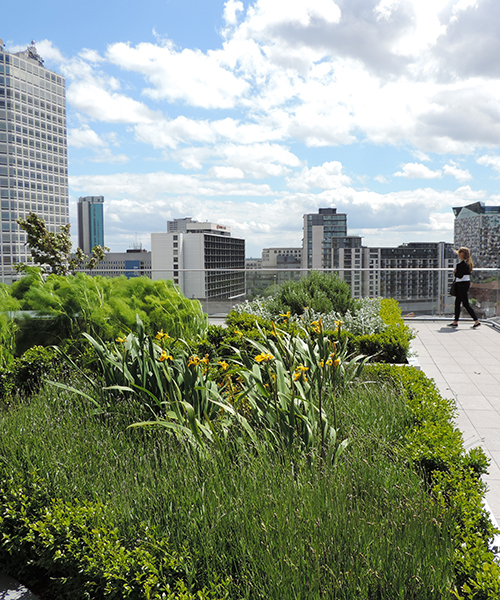
It can be difficult to show tenants the value of building investments in areas like energy efficiency. But they can clearly see solutions like green roofs, native floral landscaping, and bee habitats.
Client success story
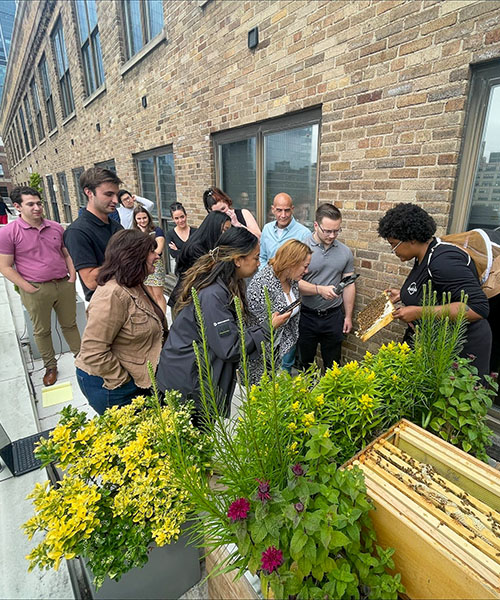
Veris Residential’s bee program invites residents to interact with their building’s sustainability initiatives:
IT’S TIME FOR THE REAL ESTATE INDUSTRY TO TAKE ACTION
The links between biodiversity, net-zero, and human health are clearer than ever. Nature must be recognized as an intrinsic part of the building life cycle. From the creation and circular management of building materials, to creating a long-term sense of place for tenants and the community.
Immediate action is required to finance and implement nature-positive measures so that the built environment can regenerate ecosystems and support the transition to net-zero.
The real estate industry has what it takes to transform cities worldwide into high-quality, connected, biodiverse habitats. It’s time to work together to combat the threat of biodiversity loss right where we live.
_b72540c5.jpeg)