
Which hands-on tenant engagement services support green building certifications?

Green building certifications now require tenant engagement programs that earn documented credits across LEED, WELL, BOMA BEST, Fitwel, BREEAM, and GRESB. Over 70% of corporate tenants require these certifications as part of their leasing criteria, according to CBRE. Property managers and asset managers need a clear map of which programs qualify and how many credits they deliver.
The answer is more practical than most guides suggest. Across seven major certification frameworks, a single nature-based program can contribute points toward multiple credit categories. Based on Alvéole's documented credit pathways, that range spans 2 to 10 points depending on the framework. It can determine whether a building reaches its target certification tier.
Here is what property managers and asset managers need to know about matching engagement services to green building certification credits.
Key takeaways
- Hands-on tenant engagement programs earn credits in LEED, WELL, BOMA BEST, Fitwel, BREEAM, and GRESB. These are not participation trophies. They are documented credit pathways. Property managers can earn green building certification points through programs already available on the market.
- Nature-based programs contribute across multiple frameworks simultaneously. A single managed beekeeping or pollinator habitat program can earn points in ecology, community engagement, biodiversity, and health promotion categories.
- Certification bodies increasingly reward community engagement and health promotion, not just energy performance. The frameworks have expanded. Property managers who focus only on building systems are leaving credits on the table.
- Structured programs with measurable outcomes earn more credits than one-off events. Documentation and measurable participation matter. Ongoing data collection supports certification requirements.
- A single managed program can contribute 2 to 10 points depending on the framework. That range reflects how different certifications weight engagement activities.
Why certifications now reward tenant engagement
Major certification frameworks now include community engagement and biodiversity in their scoring criteria alongside building systems performance. Health promotion is also weighted in frameworks like WELL and Fitwel.
Over the past five years, every major certification framework has expanded its scoring criteria to include community engagement, health promotion, and biodiversity. LEED v4.1 added ecology and site management credits, and LEED v5 (ratified March 2025) goes further by organizing its entire framework around decarbonization, quality of life, and ecological conservation. WELL v2 introduced a dedicated Community feature area. Fitwel built its entire scorecard around occupant health and engagement. BREEAM strengthened its ecology credits to assess biodiversity monitoring and habitat enhancement.
The reason is straightforward. Building owners and investors realized that a high-performance building envelope means little if tenants are disengaged and churning. Over 70% of corporate tenants now require green building certifications as part of their leasing criteria. That number, from CBRE's Global Occupier Survey, reflects how firmly certifications have become baseline expectations for tenant satisfaction in commercial real estate.
For property managers and asset managers, the financial case is equally clear. Green-certified properties earn rental premiums of 7.1% to 11.6% on average and sell at approximately 7.6% higher value, according to Verdani Partners. Those premiums depend on maintaining and advancing certifications, and that increasingly means running engagement programs that earn credits.
GRESB, the global benchmark for real estate environmental and social performance, evaluates tenant engagement on a spectrum. At the lowest level, landlords simply inform tenants about building performance. At the highest level, tenants, landlords, and property managers all play active roles in structured programs. Hands-on engagement services occupy that highest tier. Property managers who implement them score better on GRESB's Social dimension, which increasingly influences institutional investment decisions.
Certification frameworks that credit hands-on engagement
Not all certifications credit engagement activities in the same way. Here is how the major frameworks evaluate hands-on tenant engagement programs.
LEED v4.1 and v5: ecology, social impact, and quality of life
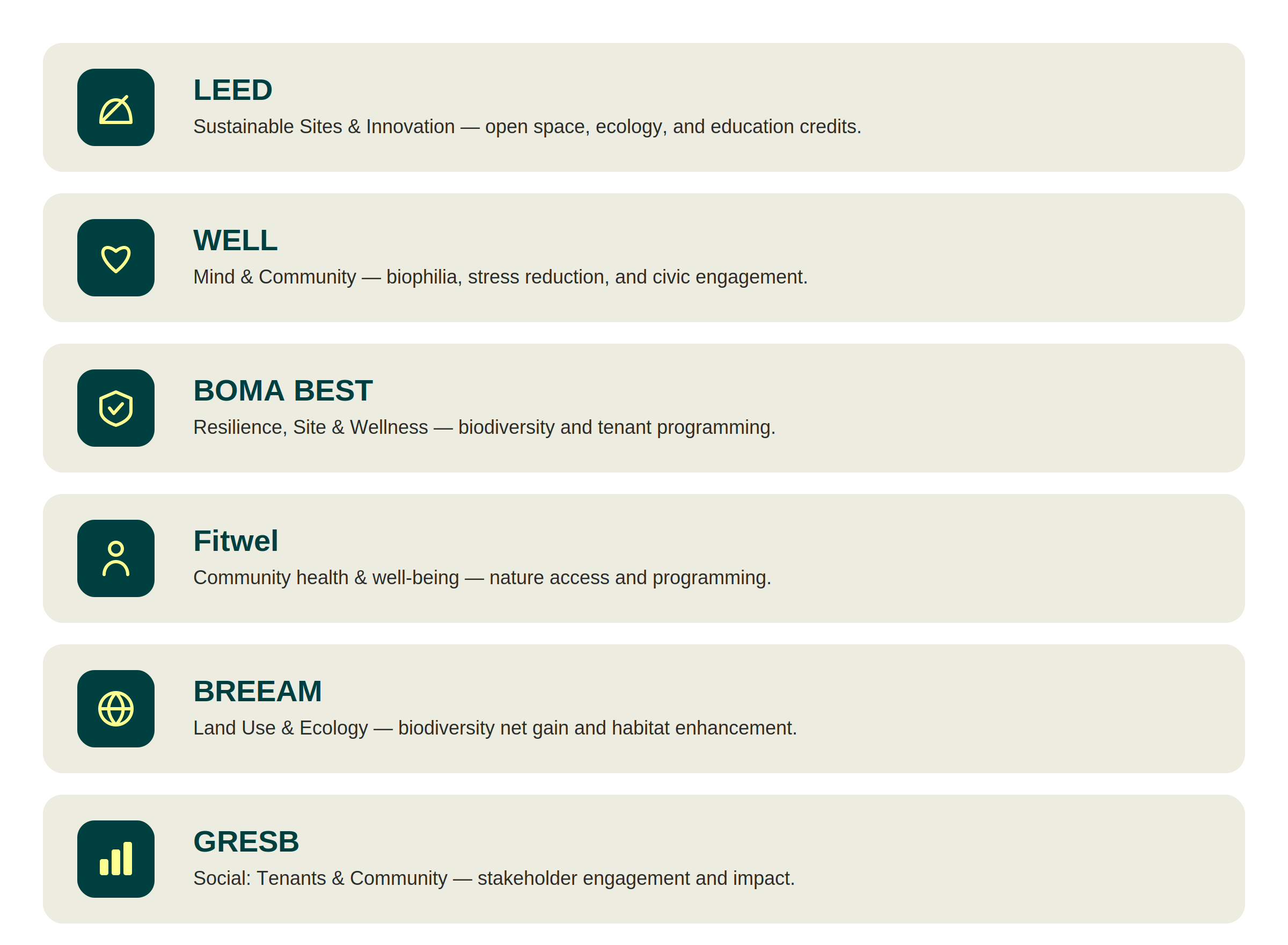
LEED v4.1 Operations and Maintenance includes credit categories that reward biodiversity initiatives and community engagement directly.
Site management and ecology credits support pollinator habitats, green roofs, and habitat restoration. Property managers who install managed beekeeping programs or pollinator gardens earn points in the Site: Habitat credit category. These credits recognize efforts to restore or protect ecological value on commercial sites.
Innovation and Regional Priority credits reward tenant engagement events that go beyond standard building operations. Educational programming, community participation in biodiversity monitoring, and green building awareness campaigns all qualify. Empire State Realty Trust, for example, earned LEED v4.1 EBOM Gold certification with Alvéole programs contributing to both ecology and engagement credit categories.
LEED v5, ratified in March 2025, raises the bar further. The newest version of LEED is built around three central impact areas: decarbonization, quality of life, and ecological conservation and restoration. For property managers focused on tenant engagement, two of those three areas directly reward hands-on programming.
The Ecological Conservation and Restoration impact area includes prerequisites and credits for biodiversity protection, habitat enhancement, and bird collision abatement. The Sustainable Sites category now emphasizes resilience and biodiversity alongside heat island reduction and light pollution controls. Nature-based programs that support pollinator habitats and ecological monitoring align directly with these expanded requirements.
The Quality of Life impact area introduces dedicated credits for social equity, community engagement, and occupant health. LEED v5 O+M adds a new Human Impact Assessment prerequisite and a Worker Safety and Training credit. A new Occupant Experience Performance credit consolidates thermal comfort, daylight, views, and acoustics into a single framework that rewards buildings actively investing in occupant wellbeing. Social equity considerations are now required, not optional, encouraging projects to prioritize community impact and accessibility.
LEED v5 also strengthens its alignment with WELL and BREEAM, making it easier for property managers to pursue multiple certifications from a single set of engagement programs.
Property managers can still register projects under LEED v4.1 through early 2026. Buildings already pursuing v4.1 should plan for v5 requirements, since engagement programs that earn credits under v4.1 are well-positioned to satisfy the expanded criteria in v5.
WELL v2: community and occupant engagement features
WELL v2 takes a different approach. It evaluates how buildings support occupant health and community connection through the WELL Building Standard.
The Community feature area rewards structured tenant participation programs. Property managers who run regular engagement events, collect feedback through occupant surveys, and create opportunities for social connection earn dedicated points. These are not optional extras. They are scored features within the certification.
Mind and Movement features credit nature access and biophilic design. Programs that bring tenants into direct contact with living systems, whether through rooftop beehives, pollinator gardens, or guided nature programming, support these credit categories. Health promotion activities managed by building staff earn additional points.
For property managers pursuing WELL certification, hands-on engagement programs serve double duty. They satisfy community engagement requirements and contribute to biophilic design and nature access credits. Alvéole's programs map directly to several of these WELL certification points with Alvéole.
BOMA BEST, Fitwel, and BREEAM: engagement across frameworks
The remaining major frameworks each approach engagement from a different angle, but all reward it.
- BOMA BEST v3 awards points for community and social engagement. Tenant communication, environmental awareness programs, and structured participation in building-level initiatives all contribute to the scoring. Property managers who document these activities with participation data and feedback earn the highest scores.
- Fitwel certification built its scorecard specifically around occupant health and engagement. Community engagement programming, access to nature, and health promotion activities run by building management are all scored. Fitwel's emphasis on nature access makes it particularly receptive to programs like pollinator habitats and outdoor engagement events. Buildings with green roofs, managed gardens, or beekeeping installations score well across multiple Fitwel categories.
- BREEAM In-Use V6 includes ecology credits that assess biodiversity monitoring, ecological management plans, and habitat enhancement on commercial sites. Property managers who implement structured urban biodiversity in real estate programs with data collection and ongoing monitoring earn the strongest scores. BREEAM's approach is especially relevant for European portfolios, where biodiversity reporting requirements are tightening.
The cross-framework opportunity is significant. A single managed nature-based program can earn credits in LEED (ecology and innovation), WELL (community and biophilic design), BOMA BEST (community engagement), Fitwel (nature access and health promotion), and BREEAM (biodiversity and ecological management). That is why these programs can contribute 2 to 10 points across seven frameworks from a single implementation.
Types of hands-on services that earn credits
Property managers have several categories of hands-on engagement services to choose from. Each maps to different certification credit pathways.
- Nature-based programs are the most versatile. Urban beekeeping, pollinator gardens, and green roof biodiversity programs earn credits across LEED (ecology and site management), BREEAM (biodiversity monitoring), WELL (biophilic design and nature access), and Fitwel (access to nature). These programs generate ongoing engagement through seasonal events, educational workshops, and harvest activities. They also produce environmental data, such as pollinator counts and habitat assessments, that support documentation requirements across frameworks. Property managers can use nature-based programs to engage tenants and earn credits simultaneously.
- Educational workshops and structured events count toward community engagement credits. Honey harvests, pollinator education sessions, seasonal nature programming, and green building awareness campaigns satisfy WELL's Community feature and BOMA BEST's tenant communication requirements. They also contribute to GRESB's Social dimension scoring. The key distinction is structure. Certification bodies score documented programs with participation tracking and learning objectives. Structured programs with clear outcomes earn the most points.
- Environmental data collection and biodiversity monitoring support the reporting and documentation requirements that certifications demand. Habitat surveys, pollinator population counts, and environmental impact reporting feed directly into BREEAM's ecological management credits, LEED's site management documentation, and GRESB's environmental reporting. Property managers who pair engagement programs with data collection earn credits in both engagement and reporting categories simultaneously.
- Green lease programs formalize tenant commitments to participation in building-level programs. These earn Green Lease Leader designation and contribute to GRESB scoring. Green Lease Leader participants have leveraged green leasing to formalize tenant engagement and document measurable energy performance improvements across commercial portfolios.
- Energy and waste engagement campaigns, including utility data sharing programs, recycling initiatives, and conservation competitions, contribute to ENERGY STAR benchmarking, LEED energy credits, and BOMA BEST resource management scoring.
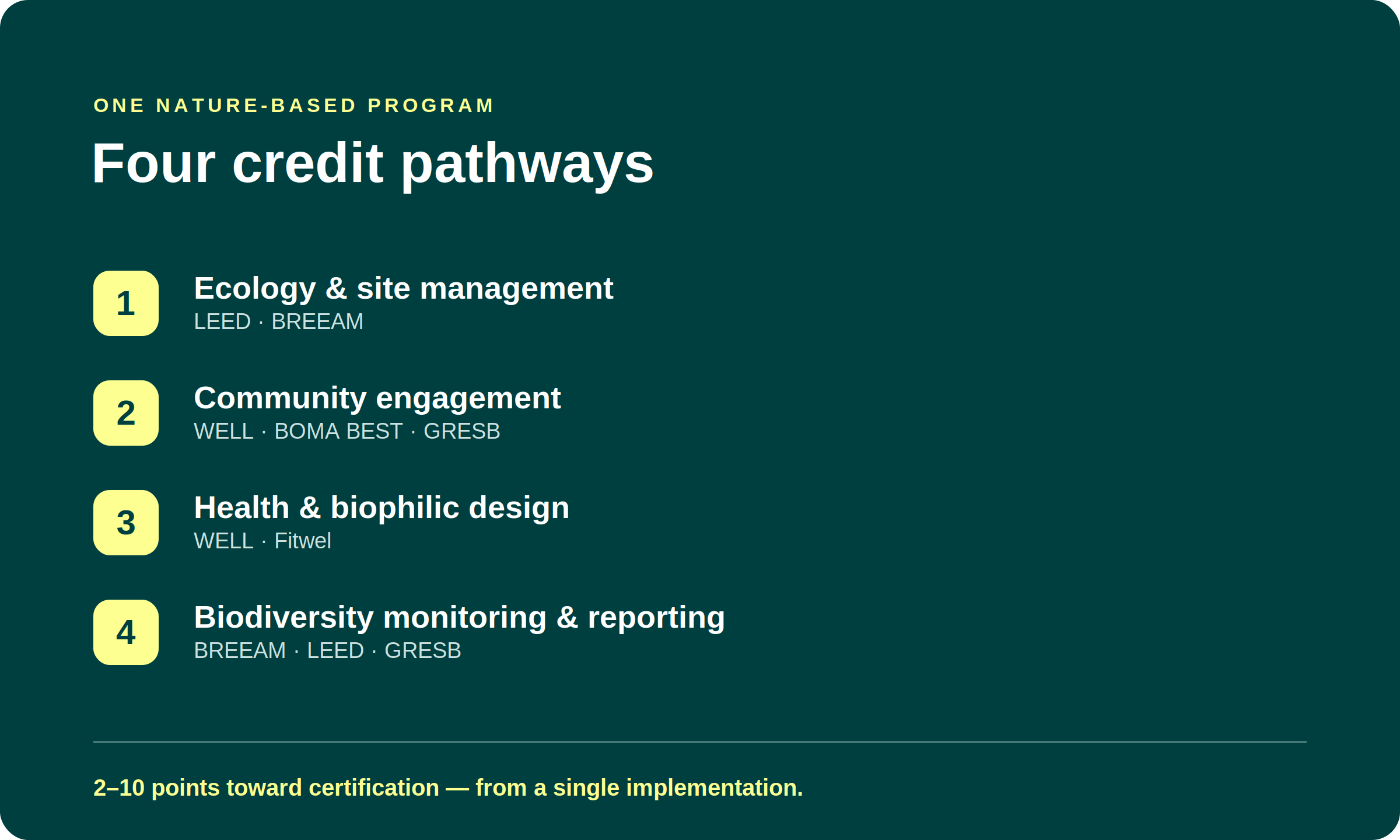
Among these categories, nature-based programs earn credits across the widest range of frameworks because they span ecology, community engagement, health promotion, and biodiversity monitoring, four distinct credit pathways from a single program.
How to choose the right program for your building
The right engagement program depends on which certifications your building is pursuing.
- Start with your certification target. For buildings pursuing LEED O+M, ecology and site management programs are the highest-value starting point. WELL certification prioritizes community engagement and health promotion. Portfolios reporting to GRESB benefit most from structured programs with data collection and documented tenant participation.
- Prioritize programs that earn credits across multiple frameworks. Many commercial portfolios pursue more than one certification. A managed nature-based program that earns LEED ecology credits, WELL community credits, and GRESB social scoring simultaneously delivers more value per dollar than single-framework initiatives.
- Choose structured, managed programs over ad hoc events. Certification bodies reward ongoing, documented participation with measurable outcomes. One-off events generate tenant goodwill but rarely earn credits. Managed programs with professional oversight, data collection, and reporting earn the most points. ENERGY STAR's practical framework for tenant engagement emphasizes the same principle: awareness campaigns, data sharing, and recognition programs succeed when they are structured into building operations.
- Pilot at one property and scale on results. Property managers do not need to commit their entire portfolio on day one. Start with a single building, document the credits earned, measure tenant participation and satisfaction, and use those results to justify expansion.
Making the business case: ROI of certification-linked engagement
The financial case for certification-linked engagement programs is concrete.
- Rental premiums. Green-certified properties earn 7.1% to 11.6% higher rents on average, according to Verdani Partners. Properties that achieve higher certification tiers command premiums at the upper end of that range. Engagement programs that push a building from one tier to the next deliver measurable rental value.
- Tenant retention. Engagement programs that include structured participation and community-building activities improve renewal rates. Even modest retention improvements at a 200-unit property, on the order of 2 to 4 percentage points, pay for the program many times over when measured against turnover costs.
- Investor benchmarks. GRESB scores increasingly influence institutional capital allocation. Properties with strong Social dimension scores, driven partly by tenant engagement activities, attract more favorable investment terms. For asset managers managing institutional portfolios, GRESB scoring is not optional.
- Cost framing matters. Managed engagement programs are operational expenses, not capital expenditures. They sit alongside event budgets and tenant services, not alongside HVAC upgrades. That distinction matters for budgeting and for how property managers present the investment to ownership.
Getting started
Property managers and asset managers do not need to build these programs from scratch. Managed, turnkey providers handle implementation, safety, data collection, and certification documentation. The programs already exist. The certification credits are already mapped.
Start with a single property. Choose a program that aligns with your certification targets. Document the credits earned and the tenant engagement outcomes. Scale based on data.
The bottom line is this: green building certification credits are available through hands-on tenant engagement programs that most buildings are not capturing. Certification frameworks, tenant expectations, and rental premium data all point to the same conclusion. The only question is whether your building is earning those credits today.
Book a demo to see how nature-based engagement programs contribute to green building certifications across your portfolio.
Frequently asked questions
What tenant activities earn points toward LEED certification?
LEED v4.1 Operations and Maintenance awards credits for site management, ecology, and innovation activities. Pollinator habitats, green roofs, habitat restoration, and structured tenant education events all qualify. LEED v5 expands on this with dedicated quality of life and ecological conservation impact areas that reward community engagement, occupant health, and biodiversity programs. Nature-based programs earn points in multiple credit categories under both versions.
How does WELL certification credit community engagement?
WELL v2 includes a dedicated Community feature area that rewards structured tenant participation programs, occupant surveys, and health promotion activities. Buildings that run regular engagement events with documented participation earn points in both Community and Mind feature categories.
Can one program contribute to multiple green building certifications?
Yes. Nature-based programs like managed beekeeping and pollinator habitats can earn 2 to 10 points across LEED, WELL, BOMA BEST, Fitwel, BREEAM, and GRESB. These programs span ecology, community engagement, health promotion, and biodiversity monitoring credit categories.
What is the ROI of green building certification for commercial buildings?
Green-certified properties earn rental premiums of 7.1% to 11.6% and sell at approximately 7.6% higher value, according to Verdani Partners. Stronger tenant retention and improved GRESB scores add to the financial case. Managed engagement programs that contribute to certification are operational expenses, not capital expenditures.
How do nature-based programs support green building certifications?
Nature-based programs earn certification credits through four pathways: ecology and site management (LEED, BREEAM), community engagement (WELL, BOMA BEST, GRESB), health promotion and biophilic design (WELL, Fitwel), and biodiversity monitoring and reporting (BREEAM, LEED, GRESB). A single managed program can contribute across all four pathways.