
How to vet beekeeping companies for commercial real estate
A managed beehive program is more than a sustainability talking point. It lives on your property, interacts with tenants, and carries real liability and reporting consequences. Before you sign, treat this vendor decision like you would any other on-site contractor.
Key takeaways
- Treat a beekeeping vendor like any other on-site contractor and run real due diligence.
- Confirm insurance names your property as additional insured, not just certificate holder.
- Ask how the provider protects tenant and employee safety.
- Require verifiable biodiversity data, not just honey jars.
- Check that the provider can scale and report across your portfolio.
Why vetting a beekeeping company matters
A managed beehive program touches tenants, sits on your roof or grounds, and links to your building's identity. Choosing the wrong vendor exposes you to safety incidents, insurance gaps, and sustainability claims you cannot back up when a disclosure deadline arrives.
Professional management is not optional. US beekeepers lost an estimated 55.6 percent of managed colonies between April 2024 and April 2025, the highest annual loss on record. That followed a 55.1 percent loss the year before. Healthy hives require hands-on expertise, regular inspections, disease management, and swarm prevention that hobbyists rarely deliver.
The market is crowded. Service providers range from hobbyists renting hive space to national operators with portfolio-scale infrastructure. Most vendor pages sell rather than inform. Asset managers, property managers, and sustainability leads need a clear process: define criteria, ask hard questions, and verify answers before signing a contract. If you want a criteria-first companion to this guide, see our overview of how to choose a beekeeping company.
What a managed beekeeping company should actually do
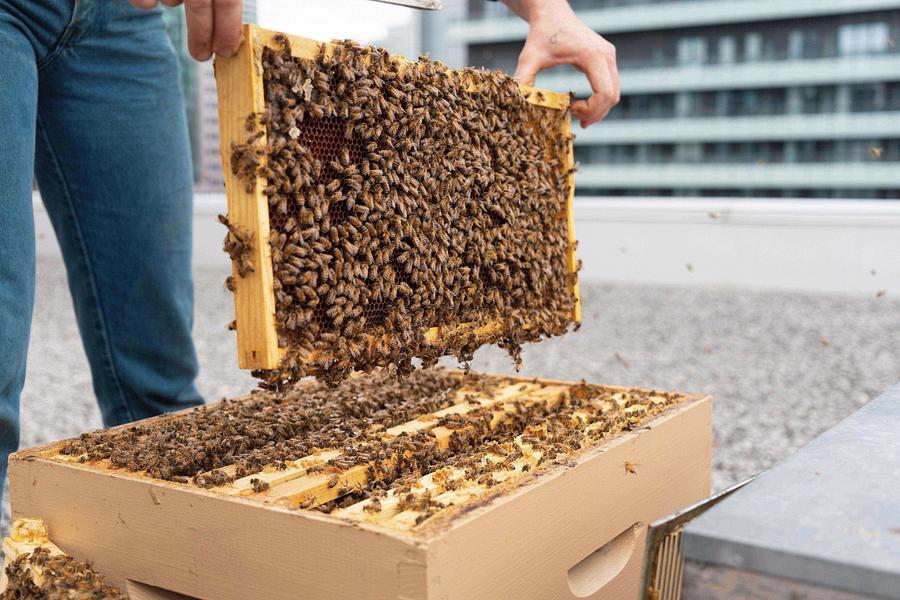
Before you compare quotes, know what you are buying. A "managed" or "turnkey" program means the provider supplies bees, equipment, and a dedicated beekeeper who visits on a regular cadence. The beekeeper handles hive health, inspections, and harvests. Your property team does not need specialized knowledge.
Standard scope typically includes health inspections, pest and disease management, seasonal feeding, swarm prevention, harvest, and branded honey. Engagement programming adds tours, workshops, honey extractions, and lunch-and-learns for tenants or employees. Some providers include a digital platform for event registration and participation tracking. For a fuller picture of the model, read our guide to beekeeping for commercial properties.
The reporting layer is where providers diverge most. Some collect real biodiversity data, package it for disclosure frameworks, and provide year-end summaries. Many do not. A clear vetting process separates the two.
Alvéole, for example, bundles hive management, the MyHive tenant-engagement platform, and on-site biodiversity data collection (floral eDNA, smart hive scales) in one service. The program operates across 2,200 buildings. That combination of scale, engagement infrastructure, and reporting data is not universal; ask each provider exactly what they deliver.
Eight questions to ask before you hire a beekeeping company
Use this checklist to vet every shortlisted vendor. The answers reveal whether a provider is built for a beekeeping service for commercial real estate or just operates at that scale.
Are you named as an additional insured on their liability policy?
Being listed as a certificate holder only means you can see the policy details. It provides no coverage. To be protected, your property should be named as an additional insured on the vendor's commercial general liability policy.
Ask for a certificate of insurance naming your property as additional insured before you sign. Red flag: a provider that only offers certificate holder status.
How do you protect tenant and employee safety?
Ask about hive placement. Hives should sit away from main entrances, HVAC intakes, and high-traffic areas. Signage should be clear. A professional beekeeper in protective gear should handle every visit.
Ask about species selection. Gentle bee strains reduce the chance of stinging incidents. Confirm how the provider responds if a tenant reports concerns.
What exactly is included, and how often do you visit?
Get scope and visit cadence in writing. Confirm that inspections, pest and disease management, feeding, swarm prevention, and harvest are included, not billed as add-ons.
Ask whether engagement events (tours, workshops, honey tastings) are part of the base contract or extra. Know what you are paying for before you compare quotes.
How do you support real biodiversity, not just honey bees?
This question tests a provider's credibility. Adding honey bee hives is not automatically pro-pollinator. Research in urban Paris found that wild-pollinator visitation rates were negatively correlated with surrounding honey bee colony density. The researchers advocate responsible practices that mitigate high-density hive introductions in urban environments.
A credible provider manages hive density and supports native pollinators. The Wild BeeHome, a habitat for solitary pollinators, is one example of how a program can broaden its impact beyond honey bees. Red flag: a vendor that equates "more hives" with "more impact" and shows no awareness of native bees.
What data do you collect, and is it reporting-ready?
Ask what the provider measures, how they measure it, and what format outputs arrive in. Biodiversity and nature-related disclosure requirements are tightening.
GRESB added a biodiversity indicator to the 2025 Real Estate Assessment. It is exploratory and not scored in 2025, but it signals where reporting is headed. LEED v5 introduced a Biodiverse Habitat credit; per third-party analysis, it requires a designated pollinator habitat, though buyers should verify specifics with a LEED reviewer. WELL rewards access to nature broadly, not beehives specifically. TNFD published final disclosure recommendations in 2023. CSRD and ESRS E4 require structured biodiversity disclosures for qualifying EU-scope entities. Do not assume all US operators are subject.
Alvéole collects on-site biodiversity data, including floral eDNA and smart hive weight monitoring, and maps it to GRESB, TNFD, WELL, LEED, BOMA, BREEAM, Fitwel, and CSRD frameworks. Ask any provider to show you a sample report, and see what makes a reporting-ready beekeeping service.
Can you scale and report across my whole portfolio?
Single-building vendors often cannot standardize service and reporting across multiple sites. For asset managers overseeing a portfolio of office or mixed-use properties, consistency matters. Our guide to choosing a provider for a portfolio covers this in more depth.
Ask whether the provider offers portfolio-level dashboards, consistent visit cadences, and aggregated reporting. MyHive, for example, gives property teams a web-based dashboard to plan events, track participation, and view biodiversity data across all buildings. If you manage ten or a hundred sites, confirm the provider can support that scope.
What experience and track record can you show?
Ask for years in operation, the number of managed sites, and references from similar property types. Local knowledge matters: an experienced provider understands municipal approvals, rooftop access, and climate-specific hive management.
Ask how they source bees and queens. A consistent supply chain keeps hives healthy. Request case studies or references you can call.
What does it cost, and what drives the price?
There is no reliable public benchmark for corporate or managed beekeeping programs. Residential pricing found online does not apply. Request an itemized quote instead.
Understand what drives cost: number of hives, visit cadence, engagement events, and the scope of data collection and reporting. Be wary of quotes that lump everything together and hide the reporting layer. If a provider cannot explain the line items, move on.
Red flags that should end the conversation
Walk away if you encounter any of the following:
- No proof of insurance, or only certificate holder status
- Vague or verbal scope with no written visit cadence
- Sustainability claims with no data or methodology behind them
- "More hives equals more impact" with no native-pollinator awareness
- No references, or no track record at portfolio scale
Any one of these signals a provider that is not ready for commercial real estate.
How to run the vetting process end to end
Turn the eight questions into a simple workflow:
- Start with a property assessment. Define where hives can safely go, what engagement programming you want, and which reporting frameworks matter.
- Request written proposals from two or three providers.
- Score each proposal against the eight questions. Require proof of additional insured status, a written scope, and sample data outputs.
- Align reporting outputs with the frameworks your team already uses, whether GRESB, LEED, TNFD, or internal disclosures.
- Confirm all safety and insurance documentation before signing.
The right provider will welcome the scrutiny.
Frequently asked questions
Define your criteria upfront. Ask the eight questions in this guide, verify insurance and safety documentation, and compare itemized quotes. Score each provider against the same checklist before making a decision.
General liability, with a certificate of insurance naming your property as additional insured. Certificate holder status alone provides no coverage. Get proof before you sign.
Yes, with professional management, proper hive placement, and clear tenant communication. A credible provider uses gentle bee strains and keeps hives away from high-traffic areas.
It can, if the provider collects verifiable data mapped to frameworks like GRESB, LEED, and TNFD. Beehives alone are not a credit. Confirm what data the provider delivers and how it aligns with your disclosure requirements.
Honey bees support pollination, but high hive density can compete with native bees. Research in urban Paris found a significant negative correlation between wild-pollinator activity and honey bee density. A credible provider manages hive placement and supports native pollinators too.
There is no reliable public benchmark. Request an itemized quote covering hives, visit cadence, engagement programming, and data collection. Compare what each provider includes before comparing price.
Bottom line
A beekeeping program is a visible, tenant-facing commitment. It affects your property's identity, your liability exposure, and your ability to back up biodiversity claims in front of investors and disclosure reviewers. Vet the vendor like any other on-site contractor.
The right partner proves safety, carries proper insurance naming you as additional insured, collects verifiable data, and delivers consistent service across your portfolio. Ask the hard questions, verify the answers, and require documentation before you sign.
Ready to see how a fully managed beekeeping and tenant-engagement program works at portfolio scale? Book a demo.

.png)
.jpg)