
Corporate beekeeping for offices: are managed services worth it?
_e852000b.jpeg)
Key takeaways
- Yes, fully managed beekeeping services exist for offices and commercial buildings. The provider installs and maintains the hives.
- A managed program typically covers hives, recurring beekeeper visits, tenant workshops, branded honey, and biodiversity data.
- Professional placement and management make bees a low-risk rooftop amenity for tenants and staff.
- The stronger office programs produce reporting-grade biodiversity data for frameworks like GRESB, TNFD, LEED, and BOMA.
- Asset managers and property managers use them to differentiate buildings and support tenant retention.
Introduction: the short answer for office buildings
Yes, managed corporate beekeeping services exist for office buildings. If you are an asset manager, property manager, or sustainability lead evaluating this option, you are not alone. More commercial real estate teams are asking about beehives because standard amenities have become interchangeable. Gyms, lounges, and coffee bars no longer stand out.
At the same time, tenant renewals are harder. Hybrid work shifted leverage to occupiers, and buildings now compete on more than location. This guide explains what a managed beekeeping service includes, whether it is safe, how much it costs, what reporting value it offers, and how to choose a provider.
What a managed corporate beekeeping service includes
Turnkey means the provider owns the work. The beekeeping company handles hive installation, recurring beekeeper visits, health checks, and seasonal care. Your property team does not need to learn beekeeping or manage the hives directly.
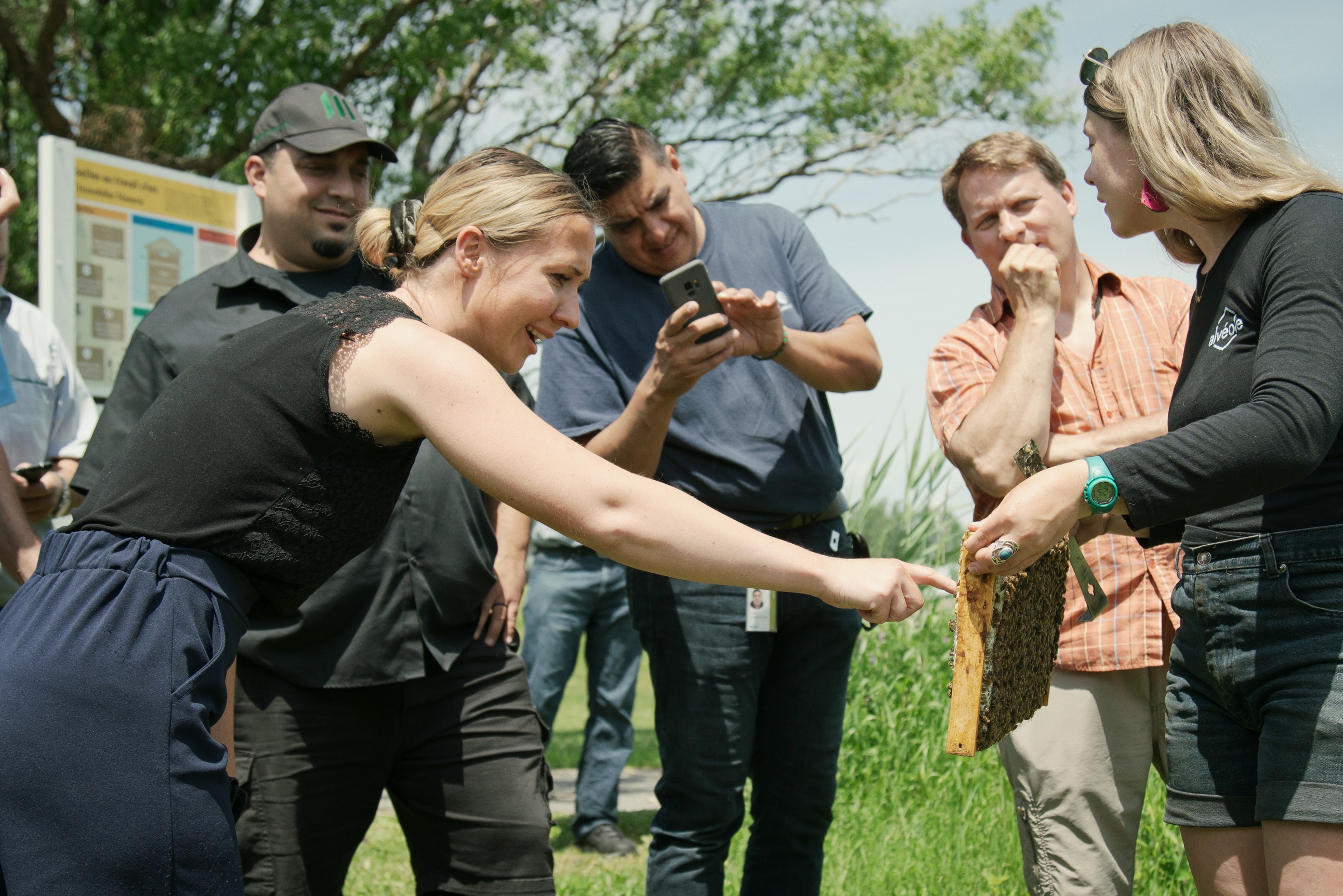
Most managed programs include recurring visits during the active season, commonly twice monthly. Beekeepers monitor colony health, inspect for disease, and prepare hives for winter. The service also includes tenant-facing programming. Hive tours, honey tastings, candle-making workshops, and team-building sessions give tenants a reason to engage with the building.
Branded honey jars harvested on-site provide leasing touchpoints, renewal gifts, and tenant event giveaways. The honey comes from your rooftop, which makes it memorable.
Digital engagement keeps tenants connected year-round. Alvéole's program, for example, combines beekeeper visits, workshops, branded honey, and the MyHive digital platform across 2,200+ buildings. MyHive lets property teams plan, promote, and measure events from a portfolio-wide dashboard. Tenants register for events, follow hive updates, and engage with the program even outside the active season.
Why office buildings are adding beehives now
Hybrid work changed the equation. When employees can work from anywhere, buildings must give them a reason to come in. Asset managers and property managers are looking for amenities that create memorable moments, not just functional space.
The data supports the shift. According to CBRE's 2024 Americas Office Occupier Sentiment Survey, 59% of occupiers are executing or exploring a move to better-quality space. 57% cite improved amenities as a motivation.
CBRE's 2025 outlook reinforces the trend. Commodity buildings in weaker districts are most at risk of losing tenants. Amenitized buildings attract relocating tenants.
Beekeeping fits this moment. It is visible, memorable, and repeatable. A hive on the rooftop gives leasing agents something to talk about. Honey extraction workshops give tenants something to attend. Unlike a one-off event, the program runs season after season.
There is also a finance angle. The program produces nature data that property teams can use for reporting and compliance. That dual value, engagement and data, is why asset managers are adding beehives now.
Is it safe to have bees at an office?
This is the most common objection, and it is reasonable to ask. The short answer: yes, with professional management and proper placement.
Honey bees are generally docile and sting only in defense of the colony. They are not aggressive. When foraging, bees focus on flowers, not people.
Placement matters. Reputable providers position hives on rooftops or in low-traffic areas. Hive entrances are angled away from foot traffic and kept clear of building entrances and HVAC intakes. Most tenants never interact directly with the bees. Beekeepers handle all hive visits in protective gear.
Insurance is part of the package. Reputable providers carry general liability insurance and can name the property as additional insured. Ask for a certificate of insurance before signing.
Before starting, confirm local regulations and any building or HOA approvals. Requirements vary by municipality. A professional provider will help you navigate this step.
What office beekeeping costs and what it delivers
Beekeeping is an operating program, not a capital project. The cost is comparable to running quality tenant events. You are not building infrastructure. You are subscribing to a managed service.
No provider publishes a flat price because it scales with the number of hives, sites, and programming. Expect a per-building or per-portfolio quote after a site assessment. This is normal for commercial real estate services that vary by property.
Here is what you get. A managed honey bee colony averages about 60,000 bees at summer peak, according to University of Arizona Extension. The colony pollinates nearby plants and produces honey for your building.
Set expectations on honey volume. USDA's 2024 national commercial average was 51.7 pounds per colony. Urban and rooftop yields vary. Some years produce more, some less. Weather, forage, and local conditions all affect output. Do not choose a provider based on honey promises.
The real value is engagement and reporting data. Branded honey jars are memorable. Workshops drive tenant participation. And the biodiversity data supports your compliance and disclosure needs. That combination is what makes the program worth the operating cost.
The differentiator: reporting-grade biodiversity data
Bees are more than an amenity. They are an indicator of local ecology. Honey bee pollination adds more than $18 billion in value to U.S. agricultural crops annually, and pollinators help produce more than 100 U.S. crops, according to USDA. Yet U.S. beekeepers lost an estimated 55.6% of managed colonies from April 2024 to April 2025, the highest annual loss since tracking began in 2010–2011, according to the Apiary Inspectors of America and Auburn University.
Reporting frameworks are responding. GRESB added its first biodiversity and nature-related indicator, RM7, in 2025. It is exploratory and unscored in 2025, aligned with the Taskforce on Nature-related Financial Disclosures (TNFD), which published its final nature-related disclosure recommendations in 2023.
Green building programs are also moving toward ecology. LEED v5 makes ecological conservation and restoration one of its core impact areas. Fitwel includes a biodiversity strategy. WELL supports nature-connected outdoor and rooftop space.
A hive on its own is not data. The program has to capture and report it. This is where a monitoring-capable provider separates from a local beekeeper.
Alvéole collects floral eDNA and monitors for pesticide and microplastic presence. The program supports GRESB, TNFD, WELL, LEEDv5, BOMA, BREEAM, Fitwel, and CSRD reporting. Nature Sensor, a bioacoustic biodiversity monitoring device, captures on-site biodiversity activity around the clock. Aura, an AI-powered nature intelligence platform, generates TNFD, CSRD, and GRESB reports in minutes. This is the capability that turns a rooftop hive into verifiable disclosure data.
How to choose a beekeeping provider for your building or portfolio
Not all beekeeping services are built for commercial real estate. Here is what to look for.
Turnkey management. Confirm the provider owns installation, maintenance, and harvest. Your team should not need to coordinate contractors or manage beekeeper schedules.
Safety and insurance. Verify professional placement protocols, docile bee stock, and general liability insurance. Ask for a certificate of insurance naming your property as additional insured.
Data and reporting. Can they produce biodiversity data mapped to your reporting frameworks? If GRESB, TNFD, or LEED matter to your portfolio, ask how the provider supports those disclosures.
Tenant engagement at scale. Is there a platform for events, updates, and portfolio-level dashboards? If you manage more than one building, you need a system, not a spreadsheet.
Track record and coverage. Ask about multi-market or portfolio experience. A provider with 2,200+ buildings has solved the operational problems that come with scale.
Alvéole meets these criteria with MyHive, advanced data capabilities, and portfolio-wide deployment. But the checklist above applies to any provider you evaluate.
Conclusion: the bottom line for office buildings
Yes, managed corporate beekeeping services exist and are built for office buildings. The right program does three jobs at once: it engages tenants, differentiates the building, and produces reporting data.
Start with a site assessment. A provider will evaluate your rooftop or greenspace, confirm suitability, and scope a program for your building or portfolio.
Ready to see how it works? Book a demo.
FAQ
Are there beekeeping services for offices?
Yes. Fully managed providers install and maintain hives at office buildings. They handle everything from recurring visits to harvest. Your property team does not need beekeeping expertise.
What is included in a beekeeping service?
A managed program typically includes hive installation, recurring beekeeper visits, seasonal care, tenant programming like workshops and tastings, branded honey jars, and biodiversity data collection. Digital platforms keep tenants engaged year-round.
Is it safe to have bees on a commercial property?
Honey bees are generally docile and sting only in defense. Professional providers place hives on rooftops or in low-traffic areas, away from building entrances. Most tenants never interact with the bees directly. Providers carry liability insurance and can name your property as additional insured.
How much does office beekeeping cost?
Beekeeping is an operating program priced per building or portfolio after a site assessment. The cost is comparable to running quality tenant events. Pricing scales with the number of hives, sites, and programming you choose.
How does office beekeeping support sustainability reporting?
A monitoring-capable program produces biodiversity data mapped to frameworks like GRESB, TNFD, LEED, Fitwel, and BOMA. Advanced providers collect floral eDNA, monitor for pesticides and microplastics, and generate disclosure-ready reports. The data supports compliance and investor reporting.