

Urban beehive services for multi-tenant offices
Urban beehive services for multi-tenant office buildings: what actually works
Key takeaways
- A managed urban beehive service installs, maintains, and harvests hives on a set schedule, so property staff do not.
- For a multi-tenant office, the service that works runs across a shared roof with one point of coordination and open access for every tenant.
- The strongest programs pair tenant engagement with verifiable, asset-level nature data for reporting.
- Cost sits in the operating budget, not capital, and scales from one building to a full portfolio.
- Ask any provider about safety siting, liability, data outputs, and reporting-framework fit.
Introduction: the shared-roof problem
You manage one roof and many tenants. That changes how a beehive program has to work. Renewal conversations are now negotiations, because hybrid work moved leverage to tenants. The asset manager walks into those talks needing documented, differentiated engagement, not goodwill.
At the same time, reviewers for GRESB, TNFD, and LP due diligence want asset-level nature data you can show. A policy statement no longer holds up on its own.
A managed urban beehive service can answer both pressures. But most guides describe a single-owner building. This one covers what a service needs to do to work in a multi-tenant office, where several companies share one address and one roof. Alvéole runs programs across 2,200-plus commercial buildings, so this is the vantage point.
What a managed urban beehive service actually does
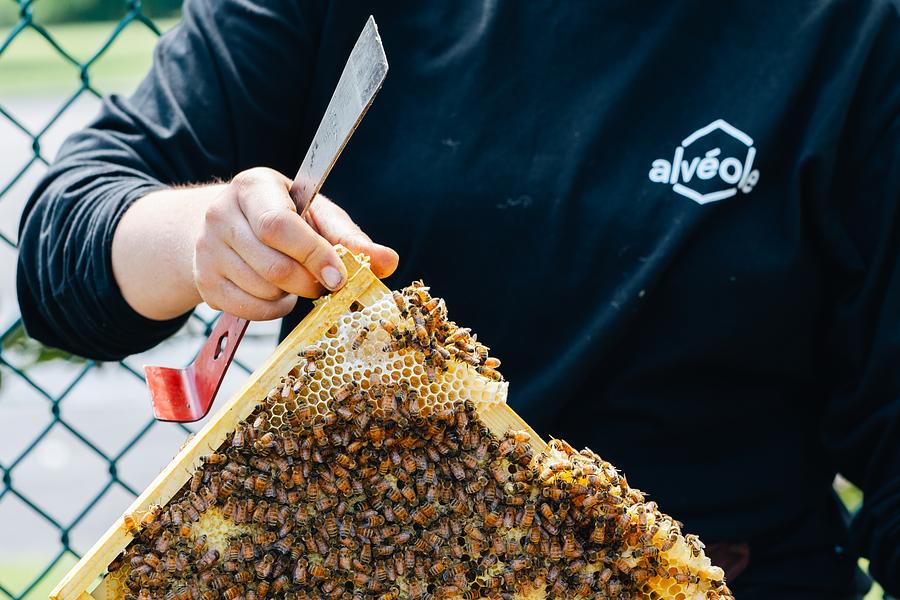
A managed service works like landscaping. The provider handles siting, installation, scheduled hive visits, and the honey harvest. Trained beekeepers do the work, not your building staff. That is the point of the arrangement.
A beekeeper visits on a set cadence, usually every few weeks through the active season. Each visit covers colony health, hive strength, and safe placement. The property manager coordinates roof access and little else. The tangible output is honey, harvested and often jarred for tenants.
Set the honey expectation correctly. A US colony produced about 52 pounds of honey on average in 2024, based on USDA figures. Some blogs cite 100 pounds. That number reflects top-producing agricultural states, not a typical rooftop hive on an office building. Give tenants an honest number up front, and the program stays credible when the first harvest lands.
What "works" for a multi-tenant office building
This is the question competitors skip. A single-tenant campus has one occupier who owns the program. A multi-tenant office does not. Several companies share the roof, and no single tenant should own or manage the hives. So the service has to be built around shared coordination.
Look for four things.
- One point of coordination. The provider manages the program at the building level. No tenant is asked to run it, and no tenant is left out.
- Open participation. Every tenant can join workshops, hive visits, and harvests, not just the anchor tenant. A shared amenity has to be genuinely shared.
- Portfolio-level tracking. The asset manager can see participation across every building in one place, which turns a nice amenity into reportable engagement.
- Near-zero lift for on-site staff. The program runs in the background while your team focuses on operations.
Alvéole's MyHive platform is built for this. It provides web-based tenant engagement, event registration, and portfolio-level participation dashboards. That gives the asset manager one view of who is participating, building by building.
Tenant engagement that holds up across tenants
In a shared building, engagement has to reach everyone. Workshops, guided hive visits, and honey harvests give every tenant something concrete to gather around. These are events with a date, a sign-up, and an attendance count, not a vague sense of community.
Custom-labeled honey jars extend the program past the events. A jar with the building's label works as a welcome gift for a new tenant and as a renewal touch for an existing one. It sits on a desk for months.
This engagement is also visible on tours and in leasing materials. A leasing agent can point to the rooftop hives and the honey tenants receive. Office tenants increasingly weigh amenities that support wellbeing when they choose and renew space. Anchor the pitch to what the program produced: events run, tenants signed up, jars handed out.
Data and reporting: what a beehive program should produce
For the asset manager, the reporting side is where a beehive program earns its keep. A credible program generates asset-level nature data a reviewer can audit, not a statement of intent.
Name the data outputs. Smart hive scales monitor hive weight in real time. Floral eDNA analysis identifies the plants bees forage on. The program can also monitor pesticide and microplastic presence. Alvéole's Nature Sensor, a bioacoustic device launched in June 2026, records on-site biodiversity activity around the clock and uses AI to identify species.
Map that data to current frameworks accurately. LEED v5 rewards restoring pollinator habitat on site through its Sustainable Sites credits. GRESB added biodiversity indicator RM7 to its 2025 real estate assessment as a disclosure question that is not yet scored. Nature disclosure is scaling fast. By late 2024, more than 500 organizations representing 17.7 trillion dollars in assets had committed to TNFD-aligned reporting. The EU CSRD, under ESRS E4, adds further nature-disclosure pressure on real estate portfolios.
Note one boundary. WELL's nature-related features are framed around occupant health, not biodiversity credits, so do not count on WELL for that. Alvéole's Aura platform pulls this data together and generates TNFD, CSRD, and GRESB reports.
Safety, liability, and roof access
Safety is the objection that stalls multi-tenant decisions, so handle it directly. Hives sit on the roof with entrances oriented away from occupied areas. Foraging bees climb well above pedestrian level as they leave and return.
Most honeybee foraging trips occur within about 3 kilometers of the hive. They are not concentrated at the entrance or at street level. Treat elevated rooftop placement as best practice for keeping flight paths clear, and pair it with professional management, signage, and clear tenant communication. Most tenants never encounter the bees directly.
Liability is a separate question in a leased building. Ask the provider who carries insurance and how the program fits your lease and roof-access terms. Get that in writing before installation.
Responsible beekeeping in a city
More hives is not automatically better for a city. Adding managed honeybee colonies without enough floral resources can crowd out wild pollinators. A Paris study by Ropars and colleagues found higher managed hive density linked to fewer wild pollinator visits.
A responsible program accounts for this. It pairs honeybee hives with wild-pollinator habitat and local forage. Alvéole's Wild BeeHome, a purpose-built habitat for solitary pollinators, runs across 500-plus buildings for this reason. This protects local biodiversity, and it strengthens the reporting story, because the asset manager can show a program designed around the site, not a box of bees on a roof.
What a beehive program costs and how to start
Treat an urban beehive service as an operating program, not a capital expense. The cost is comparable to other tenant events you already run. It scales from a one-building pilot to a full portfolio, so the asset manager can prove the model on a single asset before rolling it out.
Use a short checklist to evaluate providers:
- Shared-roof coordination: one point of contact for the whole building.
- Open tenant access: every tenant can participate.
- Data outputs: hive weight, floral eDNA, species monitoring.
- Reporting-framework fit: LEED v5, Fitwel, GRESB, TNFD, CSRD.
- Safety siting: elevated placement, professional management.
- Liability: documented insurance and roof-access terms.
Ready to see what a program looks like on your building? Book a demo.
Frequently asked questions
What urban beehive services work well for multi-tenant office buildings? The ones with one point of coordination for the shared roof, open access for every tenant, portfolio-level participation tracking, and reporting-grade data outputs. That combination fits a building with many occupiers.
Who maintains the beehives at an office building? The provider's trained beekeepers, on a set schedule. They handle hive visits, colony health, and the honey harvest. Building staff coordinate roof access and little else.
Is rooftop beekeeping safe for tenants? Placed on the roof with entrances aimed away from occupied areas, hives keep bee flight paths above pedestrians. Most honeybee foraging happens within about 3 kilometers of the hive, so they are not concentrated at the entrance. Professional management and clear signage handle the rest.
Who is liable for beehives in a leased building? Ask the provider directly. Confirm who carries insurance and how the program fits your lease and roof-access terms before installation.
How much honey does a hive produce? A US colony averaged about 52 pounds in 2024, based on USDA figures. Higher numbers usually reflect top agricultural states, not a typical rooftop hive.
**Can a beehive program help with **green building certifications** and reporting?** Yes, when it produces auditable data. It can support LEED v5 Sustainable Sites credits for pollinator habitat, and it feeds GRESB, TNFD, and CSRD disclosure with asset-level nature data.
.png)
.jpg)