
What CRE teams should compare in rooftop beehive contracts
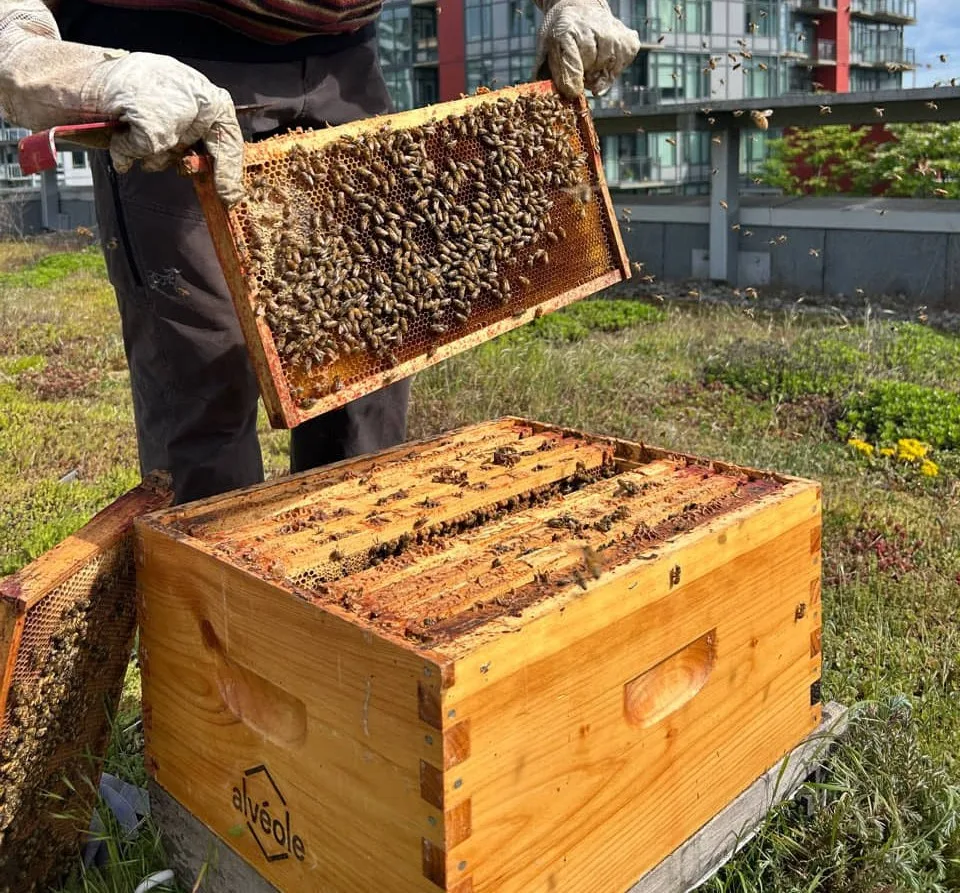
Two providers can both put a hive on your roof. The contract decides whether you get reportable data or just a rooftop photo. If you manage commercial buildings, this guide shows you the eight terms to line up side by side before you sign.
Key takeaways
- A rooftop beehive service is an operating program, not a per-hive hobby purchase. Compare the contract, not the sales pitch.
- Line up eight terms across bids: scope and service levels, cost structure, safety and insurance, regulatory compliance, data ownership, reporting support, hive density, and termination.
- The clause that separates an amenity from a liability is data ownership. Confirm you can export biodiversity data for your reporting if you switch providers.
- Ask every provider for proof of insurance and current hive registration in each market before you sign.
Introduction
Property managers should compare eight things across rooftop beehive service contracts: scope and service levels, cost structure, safety and insurance, regulatory compliance, data ownership, reporting support, hive density, and termination.
Managed beekeeping is now a working tool for commercial buildings, not a novelty. Managed honey bee pollination adds at least $18 billion to US agricultural value each year, according to the USDA. But two providers can both sell you "a hive on the roof" and deliver very different contracts. The walkthrough shows you the honey. The contract decides whether you get reportable data or just a nice photo.
First, confirm you are comparing managed services, not hobby kits
Before you score any bids, make sure they belong in the same category. A managed beekeeping service covers the bees, equipment, trained beekeepers, tenant events, data collection, and reporting inputs, all run by the provider. That is different from a hive-equipment seller or a bee-removal service, which do neither the programming nor the reporting a commercial building needs.
Professional management changes the output. In a peer-reviewed European study, professionally managed colonies had about half the winter mortality of hobbyist colonies, and inspected professional apiaries showed no signs of disease. A managed contract buys you that reliability. A kit does not.
Get the arrangement in writing. Penn State Extension treats written agreements as best practice for colony service. A verbal promise about visits and harvests is not something you can hold a vendor to. A signed scope is.
Scope of service and service levels
A full-scope contract should name every task the provider owns. Look for installation, routine hive care, pest and disease management, seasonal feeding, swarm prevention, honey harvest, tenant events, and the data inputs that feed your reporting. If a task is not named, assume it is not included.
Compare visit frequency in writing. A real provider commits to a cadence in writing, for example a scheduled visit every two to three weeks in the active season. Vague language like "regular visits" is not a commitment you can measure.
Confirm the workload on your team. In a strong contract, your staff obligation reads as "rooftop access only." Everything else sits with the provider.
Use a recognized standard as your checklist. NIST defines a service-level agreement as a commitment that names responsibilities, the type of service, the expected performance level, and the requirements for reporting, resolution, and termination. Hold each bid to that bar. With Alvéole, trained beekeepers visit on a set cadence and run the tenant events, and the property team only provides rooftop access.
Cost structure and how you are billed
Price the program the way you price tenant programming, not a capital project. A commercial beehive program is an operating expense. It runs on a service fee, not a one-time build.
Watch your benchmarks. Residential and hobbyist beekeeping is often quoted at roughly $100 to $200 per hive per month. Those figures do not describe commercial scope, and a bid that leans on them usually omits the events, data, and reporting a building needs. Compare like for like.
Read what sits inside the base fee versus what gets billed as an extra. Ask which of these are included: tenant events, honey jars and labeling, data collection, and framework-aligned reporting. A low base price with everything billed separately can cost more than a higher all-in fee.
For a portfolio, compare structures directly. A single contract with volume-based pricing is usually cheaper and easier to manage than a separate per-site agreement for every property.
Safety, insurance, and liability
Safety is the first question your tenants will ask, so compare how each provider answers it. Start with placement. Hives belong on rooftops or in screened areas, away from entrances, air intakes, and high-traffic zones. Confirm the placement standard in writing.
Confirm who handles the bees. Trained professionals should manage every hive, backed by clear signage and tenant communication. Your staff and tenants should never need to touch a hive. With Alvéole, trained beekeepers handle the hives so staff and tenants are not involved.
Compare insurance in writing, not on a promise. Ask for general liability coverage and a certificate of insurance that names your property as an additional insured. This is best practice, and it is a standard, available clause. Make that certificate a condition of signing, not a follow-up you chase after the hives are on the roof.
Regulatory compliance and hive registration
Here is an obligation most buyers miss and most providers stay quiet about. Many US states legally require apiary registration with the state agriculture department. California, New York, and Pennsylvania all require it. California enforces registration and applies penalties for unregistered apiaries, so this is not a formality you can skip.
Put the burden on the provider. Ask each bidder to prove current registration in every market where they would operate for you, and make that proof a contract deliverable, not a verbal assurance. Penn State Extension points beekeepers to register with the state agriculture department, so a professional operator should already have this handled.
This matters most for portfolios. A national operator has already cleared varied local rules across many markets. A regional patchwork of small providers has not, and the compliance gap becomes your problem. With Alvéole, permitting and registration are managed across markets, so the property team does not research local ordinances building by building.
Data ownership and reporting support
This is the core of the comparison. A hive without monitoring data is a photo. A hive with monitoring data is a line item you can disclose. The contract decides which one you get.
Start with ownership and portability. Confirm in writing that you own the biodiversity data and can export it if you end the contract. This best-practice clause is the difference between an amenity and a liability. If the data leaves with the vendor, your reporting history leaves too.
Compare how the data is captured. Hive scales, floral eDNA analysis, and bioacoustic sensors produce asset-level, species-level data tied to a specific building. Portfolio averages and generic estimates do not satisfy a reviewer asking to see the underlying program.
Then compare framework support without overclaiming. The TNFD published its recommendations in September 2023, built on four pillars: governance; strategy; risk and impact management; and metrics and targets. GRESB's 2025 to 2026 Real Estate Assessment added an unscored, exploratory indicator that asks whether the entity has a biodiversity and nature strategy. Under the EU's CSRD, ESRS E4 is a biodiversity and ecosystems standard. LEED v5 names ecological conservation and restoration as a core impact area. Ask each provider for a sample framework-aligned report from an existing client, so you see the output before you commit. Alvéole supplies MyHive dashboards, smart hive scales, floral eDNA, and the Nature Sensor, and Aura generates TNFD, CSRD, and GRESB reports. The program supports GRESB, TNFD, WELL, LEEDv5, BOMA, BREEAM, Fitwel, and CSRD.
Responsible hive density and wild pollinators
More hives is not automatically better, and a responsible provider will tell you so. Dense managed honey bee hives can compete with wild bees for forage and can spread pathogens to them.
Read the evidence carefully. In a 2017 review by Mallinger and colleagues, a majority of the reviewed studies found negative competitive effects from managed bees on wild bees, strongest within about 800 meters. A majority of the pathogen studies found potential negative effects. The word to hold onto is "can," not "will." Managed density is a risk to manage, and industry guidelines on density and disease monitoring reduce it.
So ask what the provider does beyond honeybees. A responsible provider manages hive density and adds habitat for wild pollinators. Alvéole manages density and offers the Wild BeeHome, a purpose-built habitat for solitary pollinators now running across 500-plus buildings.
Term, renewal, and termination
Read the exit terms as closely as the start terms. Compare contract length, auto-renewal, and the notice period each provider requires. An auto-renewal with a long notice window can lock you in longer than you intended.
Confirm how you can end the agreement, both for convenience and for cause. Tie termination back to your data. Confirm that your biodiversity data is portable on exit, so ending a contract does not erase your reporting history. NIST names reporting and termination as core elements of a service agreement, so a serious contract will spell both out.
For a portfolio, confirm flexibility. You should be able to add or remove properties mid-term without renegotiating the whole agreement.
A side-by-side checklist for comparing bids
Bring these questions to every vendor evaluation and score the answers against each other.
How Alvéole approaches these contract terms
Alvéole runs a turnkey managed service across 2,200-plus commercial buildings in the US, Canada, and Europe under one model. That scale lets a property manager meet all eight criteria with a single provider.
Trained beekeepers handle the hives, and Alvéole manages safety and permitting across markets. Portfolios run on a single contract rather than a separate agreement per site.
The data is asset-level and exportable through MyHive dashboards, smart hive scales, floral eDNA, and the Nature Sensor. Aura turns that data into TNFD, CSRD, and GRESB reports. Alvéole also manages hive density and adds the Wild BeeHome for wild pollinators, so the program is responsible to the site as well as reportable on paper.
Frequently asked questions
What should a rooftop beehive service contract include?
It should name eight things: scope and service levels, cost structure, safety and insurance, regulatory compliance, data ownership, reporting support, hive density, and termination. Each section above covers one. If a term is not written down, treat it as not included.
Is a rooftop beehive program an operating cost or a capital cost?
It is an operating program, priced like tenant programming rather than a capital build. Ignore residential per-hive figures of roughly $100 to $200 per month. Those do not reflect commercial scope, events, data, or reporting.
Who is liable if something goes wrong with the bees?
A professional provider carries general liability insurance. As best practice, request a certificate of insurance that names your property as an additional insured, and make it a condition of signing. Confirm trained beekeepers handle the hives.
Who owns the biodiversity data from the hive?
Whoever the contract says. Confirm in writing that you own the data and can export it if you switch providers. Without that clause, your reporting history can leave with the vendor.
Do I need a permit to keep bees on a commercial roof?
Often, yes. Many states, including California, New York, and Pennsylvania, require apiary registration, and California enforces it. Make the provider prove current registration in every market where they operate for you.
The bottom line
Compare the contract, not the pitch, across all eight terms. The best contract is safe, turnkey, data-backed, reporting-ready, and responsible to wild pollinators. A rooftop hive is easy to install. A contract that produces exportable, framework-ready data across your portfolio is the part worth comparing.
See how a managed program would work across your assets. Book a demo.
.png)
.jpg)