
How rooftop beehive installations help commercial real estate meet ESG reporting goals
Key takeaways
- Managed rooftop beehive programs generate asset-level biodiversity data that feeds directly into GRESB, TNFD, LEEDv5, and BREEAM submissions.
- Nature-based programs like beehives and wild pollinator habitats can earn green building certification points across LEED, WELL, BOMA BEST, Fitwel, BREEAM, and GRESB.
- Biodiversity monitoring technology, including bioacoustics and floral eDNA, closes the gap between policy commitments and verifiable, site-specific nature data.
- Rooftop beehive programs address both the reporting gap (disclosures for GRESB, TNFD, and LP DDQs) and the tenant engagement gap (participation rates and community building) that asset managers face.
- Alvéole operates beehive and pollinator programs across 2,200+ commercial buildings in the US, Canada, and Europe.
The reporting gap asset managers cannot close with policy documents alone
Asset managers have committed to biodiversity and nature-related disclosures. LP due diligence questionnaires now include explicit biodiversity questions. Sustainability-linked financing covenants increasingly tie loan margins to biodiversity performance. GRESB submissions require more than a policy statement.
But most portfolios lack asset-level data to prove progress.
GRESB 2025 introduced biodiversity indicator RM7, aligned with the Taskforce on Nature-related Financial Disclosures (TNFD). Over 2,200 real estate companies now participate in GRESB, representing approximately $7 trillion in property value. The indicator is currently unscored, but it signals where scored requirements are heading. Understanding why GRESB matters for CRE success is essential for asset managers navigating these changes.
TNFD published dedicated real estate sector guidance in January 2025. Over 500 organizations from 50+ jurisdictions use TNFD recommendations for annual reporting, representing over $17 trillion in assets under management. Gecina, Europe's largest office REIT by valuation, already integrates biodiversity scores into sustainability-linked loan covenants. a.s.r. Real Estate applies TNFD for nature-related reporting across its portfolio.
Meanwhile, 49% of investment funds now have a biodiversity policy, up from 44% in 2024. But having a policy is not the same as having data.
The gap is clear. Commitments are rising. Verifiable, site-specific nature data is not keeping pace. Asset managers who can produce ground-level biodiversity evidence have a reporting advantage. Those who cannot are exposed.
How rooftop beehives work as a nature-based solution for commercial buildings
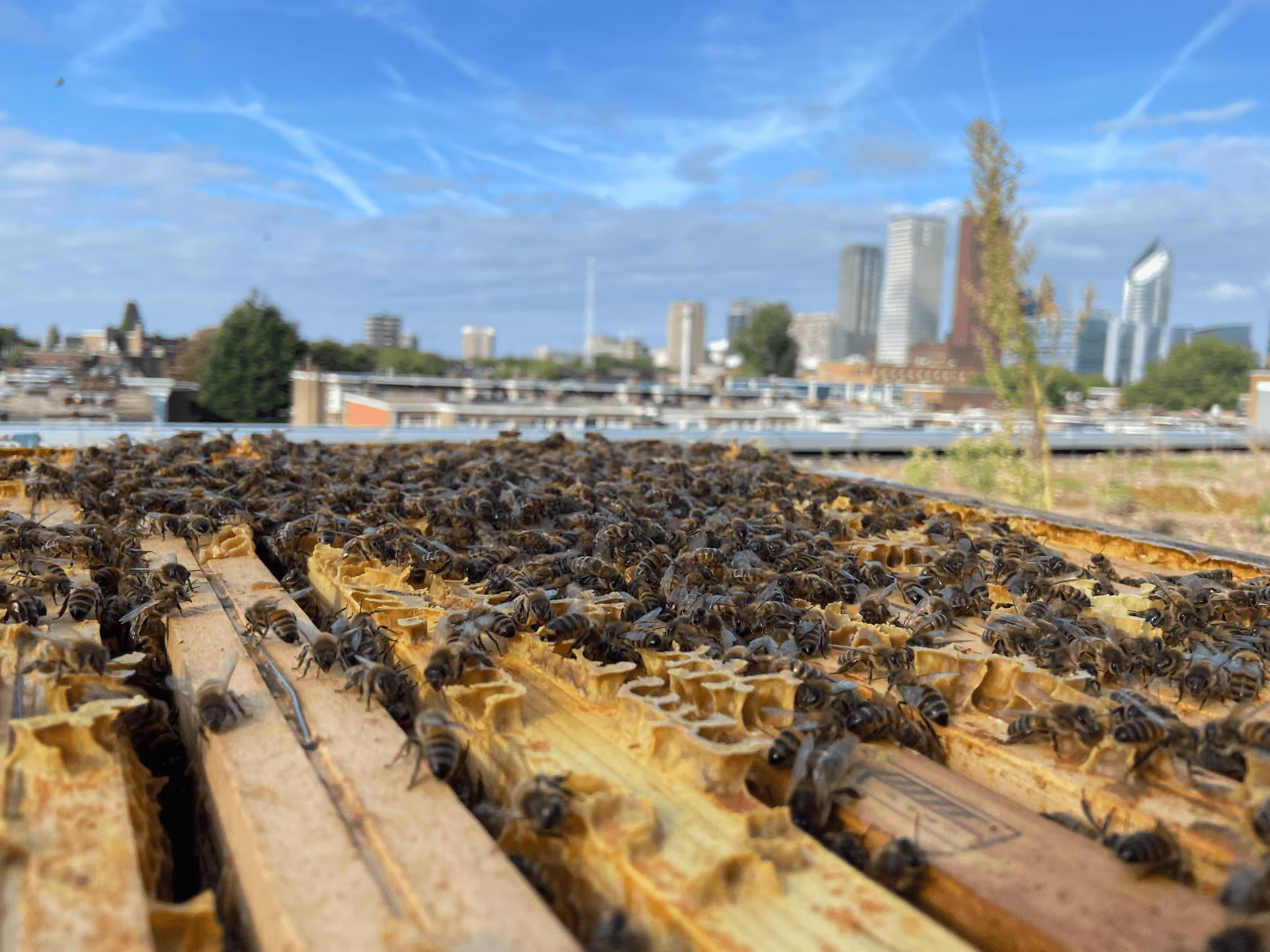
A managed rooftop beehive program places professionally maintained hives on commercial building rooftops. The service provider handles installation, seasonal care, and data collection. The asset manager receives biodiversity data, tenant programming, and certification documentation, without adding operational burden to the property team.
Urban environments can support healthy bee populations, but the picture is more nuanced than it appears. US managed honey bee colonies lost an estimated 55.6% during 2024 to 2025, the highest loss rate since tracking began in 2010. More than one in five native North American pollinator species now faces elevated extinction risk.
The broader trend matters for reporting. Global managed honeybee colony numbers reached 101.7 million in 2024, a 47% increase since 1990. But managed bee growth masks wild pollinator decline. Wild bee species recorded globally has fallen approximately 25% since the 1990s.
For GRESB and BREEAM reviewers, this distinction is important. A credible biodiversity program pairs managed honeybees with wild pollinator habitats and monitoring. Programs like Alvéole's combine rooftop beehive installations with Wild BeeHome habitat redesign for solitary pollinators, now running across 500+ buildings. That combination delivers a more complete biodiversity story for reporting and certification purposes.
Environmental pillar: biodiversity data that satisfies GRESB, TNFD, and LEEDv5
This is where rooftop beehive programs deliver their strongest reporting value. Each major framework has specific criteria that beehive and pollinator program data can address directly.
GRESB biodiversity indicators (RM7 and TC2.2)
GRESB 2025 added indicator RM7, requiring participants to describe their biodiversity dependencies, risks, and opportunities aligned with TNFD. The indicator is exploratory now. It will not stay that way. GRESB 2026 elevates indicator weights to reward actual environmental outcomes over policy documentation. The GRESB 2025 Real Estate Reference Guide details the full reporting requirements.
TC2.2 (Tenants and Community) explicitly defines “biodiversity and green space” as works to improve habitat management and green spaces within the built environment. This is not a stretch interpretation. Managed beehive programs, pollinator plantings, and wild pollinator habitats are exactly what TC2.2 describes.
Data from beehive programs (species counts, pollination records, habitat presence) fills these requirements at the asset level. Nature-based programs can contribute up to 2.6 GRESB points, according to Alvéole's portfolio data. The MyHive platform provides portfolio-level dashboards that aggregate biodiversity data across buildings for GRESB submissions.
TNFD LEAP assessment for real estate
TNFD's LEAP approach requires four steps: Locate (where does your asset intersect with nature?), Evaluate (what are your dependencies and impacts?), Assess (what are the risks?), Prepare (disclose). The TNFD real estate sector guidance provides detailed sector-specific considerations for applying this approach.
Core sector metrics for real estate include land-use change extent, pollutants including pesticides in landscaped areas, and reporting on the condition of local habitats and species.
Beehive programs provide site-specific nature data at the Evaluate and Prepare stages. Species presence records. Pollination activity monitoring. Floral eDNA analysis that verifies local plant diversity. Pesticide and microplastic monitoring from honey samples. Asset managers can learn more about TNFD frameworks for GRESB reporting to strengthen their submissions.
Over 20 real estate companies, including Landsec and Frasers Property, have already signed up as TNFD adopters. The Better Buildings Partnership published a TNFD implementation guide specifically for UK commercial real estate, sponsored by Brookfield Properties.
Nature Sensor bioacoustic device, Alvéole's bioacoustic monitoring device launched in June 2026, provides 24/7 biodiversity data collection. AI identifies species on-site without manual surveys. That data feeds directly into TNFD disclosures.
LEEDv5 biodiverse habitat credit (SSc1) and BREEAM LE 01-05
LEED v5, released in April 2025, dedicates approximately 25% of its credits to ecological conservation and restoration. That is a new major pillar, not a minor addition. The LEED v5 certification framework outlines the full scope of these changes.
The new Biodiverse Habitat credit (SSc1) is worth up to 2 points for BD+C and Core and Shell projects. Requirements are specific: at least 10 native or adapted species across 2 or more categories (trees, shrubs, ground cover), plus a minimum 110 square feet of native flowering plants for local pollinators with designated signage.
Wild BeeHome habitats and pollinator plantings directly satisfy SSc1's native flowering plant requirement.
BREEAM's Land Use and Ecology credits (LE 01 through LE 05) cover site selection through long-term biodiversity management. BREEAM v7 aligns with England's mandatory Biodiversity Net Gain requirement, which sets a 10% minimum for all new developments. Alvéole provides BREEAM certification support to help asset managers navigate these credits.
Across all frameworks, nature-based programs can earn 2 to 10 certification points spanning LEED, WELL, BOMA BEST, Fitwel, BREEAM, and GRESB. Empire State Realty Trust earned LEED v4.1 EBOM Gold with Alvéole programs contributing to both ecology and engagement credit categories.
Alvéole provides certification documentation for seven frameworks. The asset manager does not need to build the submission package from scratch.
Social pillar: tenant engagement that shows up in reporting and renewals
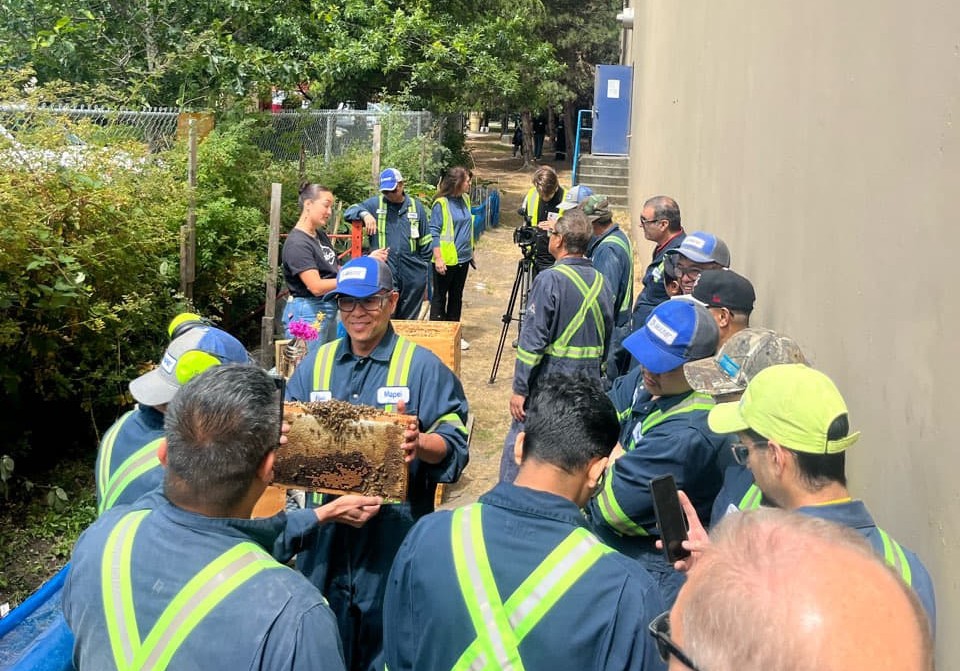
Beehive programs produce something most amenities do not: participation data. Hive inspections, honey harvests, educational workshops, and seasonal events generate documented attendance, registration numbers, and engagement rates. That data is reportable under GRESB's TC2.2 (community engagement) and WELL's community features.
LEED v5 O+M includes expanded Quality of Life credits with a Human Impact Assessment prerequisite. Social equity is now a required element, not optional.
For asset managers facing renewal negotiations, this matters. Hybrid work has shifted leverage to tenants. Renewals are real negotiations now. Asset managers need documented evidence of differentiated amenities at renewal time, not instinct or tenant improvement concessions.
A beehive program gives the leasing team something concrete to present. Participation rates. Event photos. Tenant feedback. A branded amenity that the building down the street does not have.
The social pillar is where the reporting gap and the engagement gap overlap. GRESB wants community engagement data. Tenants want programming that makes the building worth coming to. One program addresses both. MyHive tracks participation rates across every building in the portfolio. Asset managers can pull engagement reports for GRESB submissions and renewal presentations from the same platform.
Governance pillar: verifiable data and third-party monitoring
What data does a managed beehive program actually produce?
This is the question that separates a marketing amenity from a reporting tool. A full-service managed beehive program produces five categories of verifiable data:
- Smart hive scales: Real-time hive weight data tracks colony health and seasonal activity without manual inspections.
- Floral eDNA analysis: Verified inventory of plant species pollinated by on-site bees. This is a direct, auditable measure of local biodiversity.
- Bioacoustic monitoring: AI-powered species identification from sound recordings. Detects pollinators, birds, and other indicator species 24/7. Nature Sensor, launched in June 2026, provides this at scale.
- Pesticide and microplastic monitoring: Environmental quality data drawn from honey samples.
- Portfolio-level dashboards: MyHive aggregates data across 50 to 200+ buildings for fund-level reporting.
As Robeco noted in its biodiversity landscape report: “Unlike climate change where we have a single metric (GHG emissions), we will not have a globally accepted methodology to calculate biodiversity loss.” Site-specific monitoring with multiple data streams is how asset managers close that gap.
How biodiversity data feeds into investor due diligence
ILPA's Due Diligence Questionnaire 2.0 includes an explicit biodiversity question in Section 19, asking about “biodiversity loss resulting from construction in an open space.” Asset managers who can show site-specific biodiversity data, not just a policy document, have a stronger answer.
The financing implications are real. Gecina integrates GRESB and BREEAM scores into sustainability-linked loan covenants, including biodiversity score triggers that affect pricing. Link REIT channels biodiversity scores into loan covenant margin adjustments. These are not theoretical scenarios. They are current practice at major global REITs.
Half of investment funds now use third-party biodiversity data providers, up from 36% in 2024. Asset managers with auditable, site-specific biodiversity data have a financing advantage. Alvéole's data outputs, including eDNA results, AI species identification, and portfolio dashboards, are built to satisfy LP and lender due diligence requirements.
What implementation looks like: cost, safety, and scale
Safety: Managed programs handle all hive care. Bees at rooftop height are docile and away from foot traffic. Professional beekeepers manage every inspection and harvest. The service provider carries liability insurance.
Cost: Managed beehive services typically run $100 to $200 per month per hive. Wild pollinator habitats like Wild BeeHome have lower cost with no active maintenance required. This is an operational expense, not a capital project.
Scale: A program proven across 2,200+ commercial buildings is not experimental. It works on office towers, mixed-use developments, logistics facilities, and retail assets. Alvéole handles installation, seasonal care, data collection, and certification documentation. The asset manager's operational burden is near zero.
Timeline: Installation is seasonal, typically in spring. Data collection begins immediately. First certification documentation is available within one reporting cycle.
Frequently asked questions
How do rooftop beehives directly support GRESB and TNFD reporting?
Beehive programs generate site-specific biodiversity data, including species counts, pollination records, and floral eDNA analysis. That data feeds into GRESB indicator RM7 and TNFD's LEAP assessment at the Evaluate and Prepare stages. Nature-based programs can contribute up to 2.6 GRESB points and provide the asset-level nature data TNFD sector guidance requires for real estate.
What green building certification credits can a beehive program earn?
Managed beehive and pollinator programs can earn 2 to 10 points across LEED, WELL, BOMA BEST, Fitwel, BREEAM, and GRESB. LEED v5's new Biodiverse Habitat credit (SSc1) is worth up to 2 points and explicitly requires pollinator habitat with native flowering plants and designated signage. Alvéole provides LEED certification requirements documentation to simplify the submission process.
What data does a managed beehive program produce for sustainability reports?
A full-service program produces smart hive scale data for colony health monitoring, floral eDNA analysis for local plant diversity verification, bioacoustic species identification for pollinator and wildlife counts, pesticide and microplastic monitoring, and portfolio-level dashboards. This data feeds directly into GRESB, TNFD, BREEAM, and LEEDv5 submissions.
Is rooftop beekeeping safe for building tenants and occupants?
Yes. Managed programs place hives on rooftops, away from foot traffic and common areas. Professional beekeepers handle all maintenance, inspections, and harvests. Bees at rooftop height are docile and rarely interact with building occupants. The service provider carries full liability insurance.
Do wild pollinators matter more than honeybees for biodiversity reporting?
Both matter, but GRESB and BREEAM reviewers increasingly look for programs that go beyond a single species. Wild bee species recorded globally fell approximately 25% since the 1990s, even as managed honeybee colonies grew 47%. The IPBES pollination assessment report documents the critical role pollinators play in food production and biodiversity. Programs that pair honeybee hives with wild pollinator habitats, like solitary bee homes, deliver a more complete biodiversity story for certification reviewers.
See how rooftop beehives fit your portfolio's reporting goals
Rooftop beehive and pollinator programs generate the biodiversity data asset managers need for GRESB, TNFD, LEEDv5, and BREEAM submissions, while giving tenants programming that makes the building stand out at renewal time. One program. Two problems solved.
See how Alvéole's managed programs map to your portfolio's specific certification targets.
_b72540c5.jpeg)