

How rooftop beehives support ESG and biodiversity goals
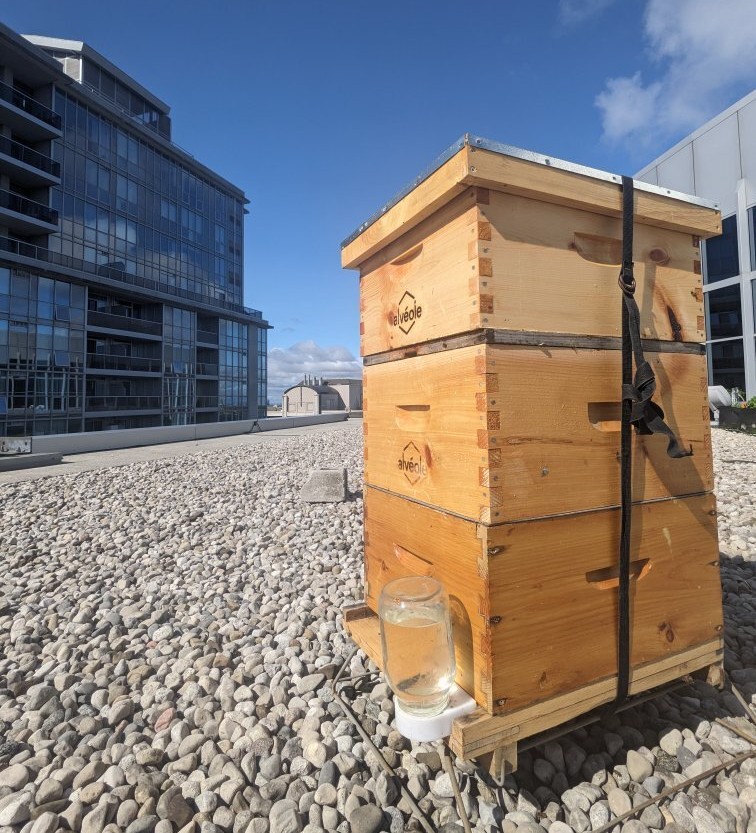
How a rooftop beehive supports ESG reporting and biodiversity goals
Key takeaways
- A rooftop beehive contributes to reporting when it produces verifiable, asset-level nature data, not just a visible amenity.
- Hive data can feed GRESB's 2026 net habitat gain metric and inform TNFD and CSRD disclosures.
- Honey bees are not native pollinators. A defensible biodiversity claim pairs hives with wild pollinator habitat and density management.
- Pollen DNA analysis and bioacoustic monitoring turn a hive into a measurement point, not a marketing prop.
Commercial real estate asset managers face a proof gap. You have made sustainability commitments to investors, LPs, and certification bodies. You need to document what those commitments produce at the asset level. A rooftop beehive is visible. Visibility is not disclosure.
This article takes a clear position. A rooftop beehive supports your reporting goals when it generates verifiable data and is run responsibly. It does not support them when it stays a photo on a leasing deck. The difference is measurement, and it is the difference reviewers now ask about.
How rooftop beehives connect to reporting frameworks
The frameworks you report to are tightening around biodiversity. That works in your favor when your assets carry real habitat data.
GRESB is the clearest example. In the 2025 assessment, its biodiversity strategy indicator was an unscored test of new criteria. GRESB has signaled that biodiversity, including a net habitat gain measure, will carry more weight in future assessment cycles. On-site habitat can contribute to that kind of metric where it is material to the asset.
TNFD works differently but points the same way. It is a market-led, science-based framework with four disclosure pillars: Governance, Strategy, Risk and impact management, and Metrics and targets. Its LEAP approach, Locate, Evaluate, Assess, and Prepare, helps a real estate portfolio assess nature-related dependencies, impacts, risks, and opportunities. TNFD has also published sector guidance for real estate. Hive data is one input to that assessment, not the whole answer.
CSRD adds a European layer. Its reporting standards ask large companies to disclose biodiversity impacts, and both the scope and the timeline are still changing, so confirm your obligations with legal counsel.
Certifications reward pollinator work too. LEED v5 puts new emphasis on ecological conservation, including on-site habitat. SITES certifies landscapes that enhance biodiversity and provide pollinator and wildlife habitat. Fitwel's Support Biodiversity credit rewards native planting, invasive-species management, and occupant education. WELL v2 has no specific pollinator credit, so do not claim one.
From visible amenity to reportable data
Here is the shift to make. Stop treating the hive as decoration and start treating it as a data point. Alvéole's Aura platform generates TNFD, CSRD, and GRESB reports, and the program supports GRESB, TNFD, WELL, LEED v5, BOMA, BREEAM, Fitwel, and CSRD. The report is only as strong as the data underneath it.
What makes hive data verifiable
Verification is where most rooftop programs stop and where reviewers start. A defensible disclosure needs data you can trace back to the asset.
Pollen DNA metabarcoding is one source. It reads the plant DNA in honey to characterize the surrounding floral landscape, detects more plant species than observation, and suits urban settings. Treat it as indicative and semiquantitative, not exact, because reference databases are still incomplete. Used carefully, it lets a hive's honey stand in as a record of the plants bees foraged nearby.
Bioacoustic monitoring is a second source. IoT sensors estimate flying-insect abundance from buzz recordings and track reasonably well against traditional insect traps. They estimate abundance. They do not yet identify species, so report them for what they measure.
Environmental DNA, or eDNA, is a third. It is trace DNA that organisms leave on flowers, in water, or in soil, detectable without capturing the organism. Abundance estimates from eDNA remain limited.
Smart hive scales add continuous colony-weight data. Together these feed Alvéole's MyHive dashboards and year-end reports. Alvéole's smart hive scales, floral eDNA analysis, and Nature Sensor bioacoustic monitoring are the tools that move a hive from anecdote to record.
The honest part: honey bees are not a biodiversity fix
This is the part most vendors skip. An asset manager should not.
Honey bees are managed livestock. They are not native pollinators. In dense urban settings, they can reduce wild pollinator diversity through competition for floral resources. The evidence is peer-reviewed. In Paris, researchers found wild pollinator visitation was negatively correlated with honey bee colony density; the authors advocate responsible practices that mitigate high colony density. In Montréal, colonies grew more than twelvefold between 2013 and 2020, and higher honey bee abundance was associated with lower wild-bee species richness, with small bees most affected.
So a rooftop beehive, on its own, is not a biodiversity gain. It can be the opposite if you saturate a neighborhood. Responsible practice fixes this. Pair hives with wild pollinator habitat. Add floral resources. Avoid saturation. Monitor local density. That honesty is what makes the reporting claim hold up when an LP or a GRESB reviewer pushes on it. Alvéole's Wild BeeHome, a habitat for wild solitary pollinators now running across 500-plus buildings, is the responsible complement to a honey bee hive, not an afterthought.
Why the pollinator context matters now
The stakes are documented. About 35% of the world's food crops and roughly 75% of flowering plants depend on animal pollinators, and more than 100 US crops rely on pollination, per the USDA.
Managed honey bee numbers have fallen. US colonies dropped from about 5.9 million in 1947 to 2.71 million on January 1, 2024, according to USDA NASS, and the winter 2024 quarterly loss was 15%. Native species are under more pressure still. The rusty patched bumble bee has declined about 87% since the late 1990s and is listed under the Endangered Species Act, per the USDA.
Reporting frameworks are tightening at the same time. Documented, responsible action now protects the disclosures you will file in future cycles.
What a managed rooftop program includes
Feasibility questions are fair, and the answers are routine. A managed program is turnkey. Professional beekeepers handle the colonies. Hives sit on rooftops or in screened areas, with signage and insurance in place. Most tenants never encounter the bees directly.
The program also gives people something to do. Tenants and employees join hive visits, honey harvests, and education sessions. That participation is what makes the data collection sustainable across a full year.
For an asset manager, the portfolio view matters most. MyHive tracks participation and results across buildings, so outcomes roll up to the portfolio, not just one roof. Alvéole runs programs across 2,200-plus commercial buildings.
Book a demo: https://www.alveole.com/book-a-demo/
Key takeaways and bottom line
A rooftop beehive supports your reporting goals when it produces verifiable data and is run responsibly. Visibility alone is not disclosure. Pair honey bees with native pollinator habitat and on-site measurement, and the hive becomes a defensible line in your GRESB, TNFD, or CSRD reporting rather than a nice story.
Frequently asked questions
How do rooftop beehive installations support ESG and sustainability goals?
They support reporting when they generate verifiable, asset-level data. That data can feed GRESB's net habitat gain metric and inform TNFD and CSRD disclosures. Pollinator habitat can also count toward certification credits. A hive without measurement supports none of this.
Do rooftop beehives actually help biodiversity?
Only alongside native pollinator habitat and density management. Honey bees are managed livestock and can compete with wild bees in dense urban areas. Paired with wild pollinator habitat and monitored for density, a program can support local biodiversity rather than crowd it.
Is it safe to have beehives on a commercial building?
Yes, under professional management. Hives are sited on rooftops or in screened areas, with signage and insurance. Most tenants never encounter the bees directly.
Can beehive data count toward green building certifications?
Pollinator habitat is recognized by LEED v5, SITES, and Fitwel. WELL v2 has no specific pollinator credit. Confirm eligibility against the full credit requirements before you claim points.
How is the biodiversity impact measured?
Through pollen DNA analysis, bioacoustic monitoring, and hive-weight data. Pollen DNA is indicative and semiquantitative. Bioacoustic sensors estimate insect abundance but do not identify species. Results are a signal, not a full census.
.png)
.jpg)