
Commercial building amenities that run themselves

Key takeaways
- Most commercial building amenities add operational load. Portfolio operators need programs, not more spaces to staff.
- Nature-based amenity programs (urban beekeeping, pollinator habitats, biodiversity monitoring) are fully managed by a third-party partner. Property teams provide rooftop access and nothing else.
- Properties with strong tenant satisfaction programs report higher renewal rates and command rent premiums of up to 12%, according to USGBC-cited research. Low-maintenance programs deliver these outcomes without adding headcount.
- LEED v5, GRESB, and TNFD now include biodiversity-specific credits and reporting requirements. Nature-based programs generate the data asset managers need for compliance and disclosure.
- Asset managers can pilot at a single building and scale across a portfolio based on measurable results.
The amenity problem no one talks about at portfolio scale
Be honest. When was the last time a tenant got genuinely excited about your lobby renovation?
U.S. office vacancy hit a record 19.6% in 2026, according to IBISWorld's commercial real estate analysis. Tenants are consolidating into higher-quality, amenity-rich spaces, and legacy buildings without a compelling story are losing ground. The flight to quality is no longer a trend. It is a market correction.
Most amenity guides assume you manage one building. They list what to install: a gym, a lounge, a coffee bar. That advice breaks down when you oversee 10, 50, or 100+ properties. Portfolio operators face a different question entirely. What can I standardize and repeat across dozens of assets without creating operational drag?
Property management teams are already stretched. Staffing and prioritization are the top challenges for property teams working with fewer resources. Adding another amenity space that needs dedicated staff, equipment maintenance, and insurance does not solve a portfolio problem. It multiplies it.
This article is not about amenity spaces. It is about amenity programs, specifically programs designed to scale across a portfolio with zero additional staff burden. The distinction matters, and it starts with understanding what separates the two.
Amenity programs vs. amenity spaces: why the distinction matters for asset managers
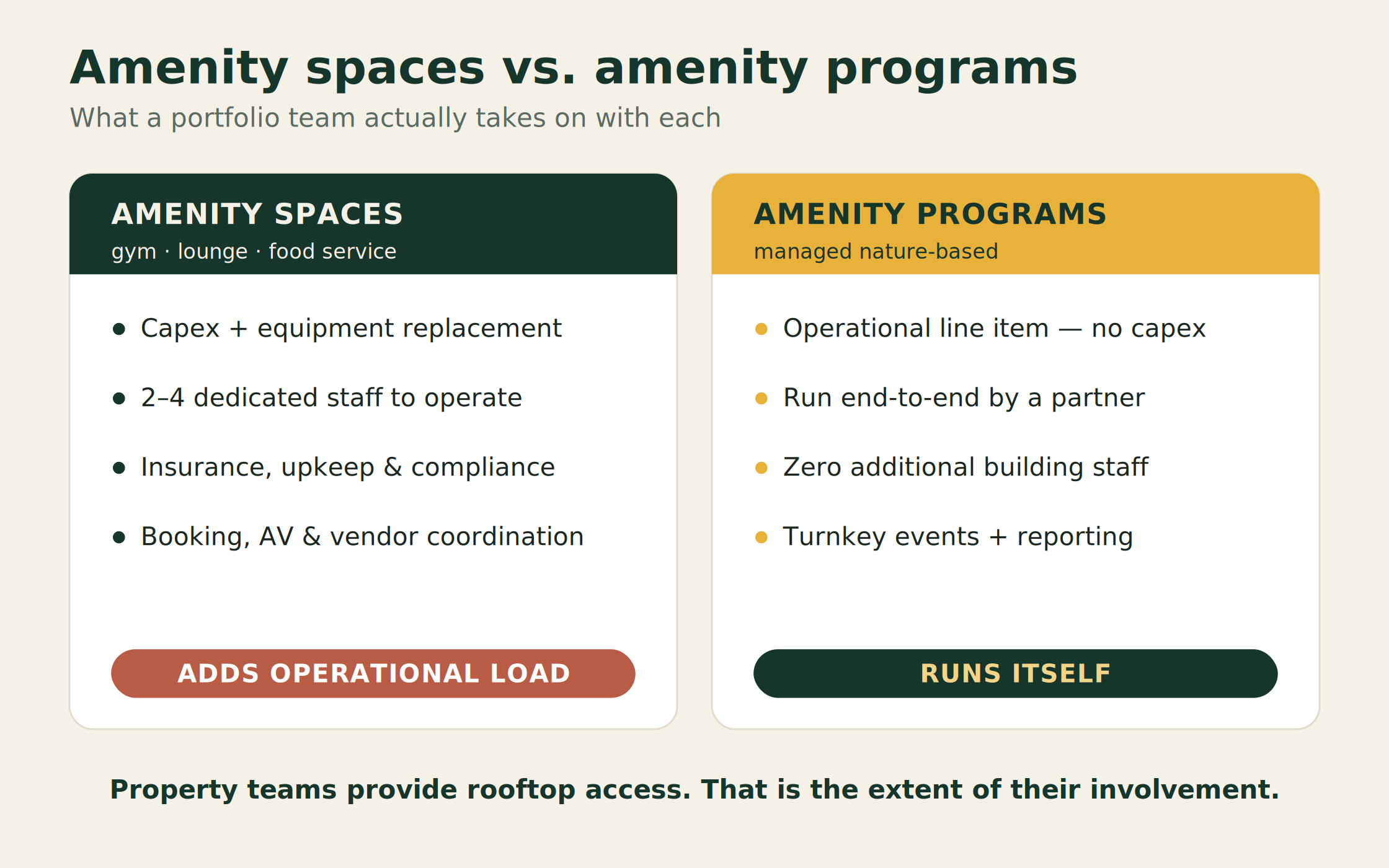
A gym is a space. It requires capital expenditure, equipment replacement cycles, dedicated staff, and insurance. A managed beekeeping installation with educational events is a program. Both appear on a property tour. Only one runs itself.
Amenity spaces demand ongoing investment from property teams. Conference rooms need booking systems and AV maintenance. Fitness centers need 2-4 dedicated staff members and equipment upkeep. Food service programs require daily vendor coordination and health compliance oversight. Every space you add is another line item on your operations team's already full plate.
Amenity programs work differently. They are operational line items managed by a third-party partner. The partner handles installation, maintenance, programming, and reporting. Your property team provides access. That is the extent of their involvement.
Effective amenity programs pass four filters: scalability across buildings, minimal lift on the property team, measurable outputs, and content and reporting value. If your property managers are sourcing speakers, managing RSVPs, or coordinating setup, the program is adding operational load, not removing it.
The market is moving in this direction. 39% of CRE professionals plan to add amenities in the next few years, and outdoor spaces, community gardens, and green space rank among the top additions, according to a Building Engines and BOMA survey of 251 CRE professionals. The same survey found that 67% of property teams say tenant comfort is the most common request they receive. The demand is real. The question is whether the amenity you add solves the demand without overwhelming the team delivering it.
Four reasons nature-based programs outperform standard amenities
A leasing moment prospects remember. Most Class A tours follow the same script: lobby, gym, conference room. Nature-based programs break the pattern. A rooftop beehive or pollinator garden gives leasing agents a story no other building on the tour circuit can tell. Leasing teams receive ready-to-use talking points and marketing content. No sourcing, no event planning, no coordination required from property staff. Daniel Farley, Building Amenity Manager at Nuveen, put it this way: “It's a great leasing initiative. It's something that many buildings don't offer, and that really stands out as an identifier for the portfolio and for the company.”
Tenant engagement that generates data. Nature-based programs produce measurable engagement, not just feel-good moments. Nuveen's 730 Third Avenue in New York reported 30-40% building-wide engagement with their nature-based program. Compare that to typical corporate event attendance of 5-15%. 73% of people globally say more greenery near their workplace would improve wellbeing. The demand for nature in the built environment is not niche. It is mainstream. Events like hive checks, honey harvests, and pollinator garden workshops produce participation data, social media content, and tenant feedback that property teams can report directly to ownership and investors.
Retention incentives that cost less than turnover. Biophilic design elements correlate with higher renewal rates, according to Harvard Business Review research on biophilic design. Alvéole's tenant satisfaction strategies that predict lease renewals break down the connection between amenity programs and renewal economics. Commercial tenant turnover costs are substantially higher than residential due to TI allowances, downtime, and broker commissions. A single retained lease can offset years of program costs. Tangible renewal touches matter. Branded honey with the building's label, seasonal programming invitations, and harvest events keep the property top of mind between lease cycles. These are retention tools that cost a fraction of a tenant improvement package.
Green certification and biodiversity reporting value. This is where nature-based programs pull away from every other amenity type. LEED v5 dedicates 25% of its total points to Ecological Conservation and Restoration. The new Biodiverse Habitat credit (2 points) rewards pollinator pathways and wildlife-friendly design. GRESB added question RM7 in 2025, requiring buildings to report whether they have a biodiversity plan. TNFD's sector guidance for real estate, published January 2025, references the Pollinator Habitat Scorecard as a biodiversity assessment tool. Certified buildings command rent premiums in major markets, according to Mordor Intelligence citing USGBC data. A nature-based program generates the environmental data asset managers need for these frameworks. It feeds directly into certification and disclosure workflows. A gym does not.
Results portfolio operators can report to ownership
Properties running nature-based amenity programs report measurable outcomes across the metrics that matter to ownership and investors:

- Lead conversion: Properties featuring nature-based amenities in marketing materials report 15-25% increases in lead conversion.
- Renewal rates: Tenant participation in nature-based programming correlates with 2-4 point renewal rate improvements.
- Event participation: 20-30% of tenants participate in nature-based programming, well above typical corporate event benchmarks of 5-15%.
- Social engagement: Honey harvests, educational sessions, and pollinator workshops generate organic content tenants want to share. No content calendar required.
BGO's 757 Third Avenue in New York won Earth Building of the Year at the 2024 NYC BOMA Pinnacle Awards. Christopher Gildea, Senior General Manager at JLL, manages the property: “This solution outweighs the cost a thousandfold. It's one of my favorite amenities at the building.”
At a commercial property, even a modest improvement in lease renewals offsets program costs many times over through avoided vacancy, TI allowances, and broker commissions.
What portfolio operators ask before they commit
Safety and tenant communication
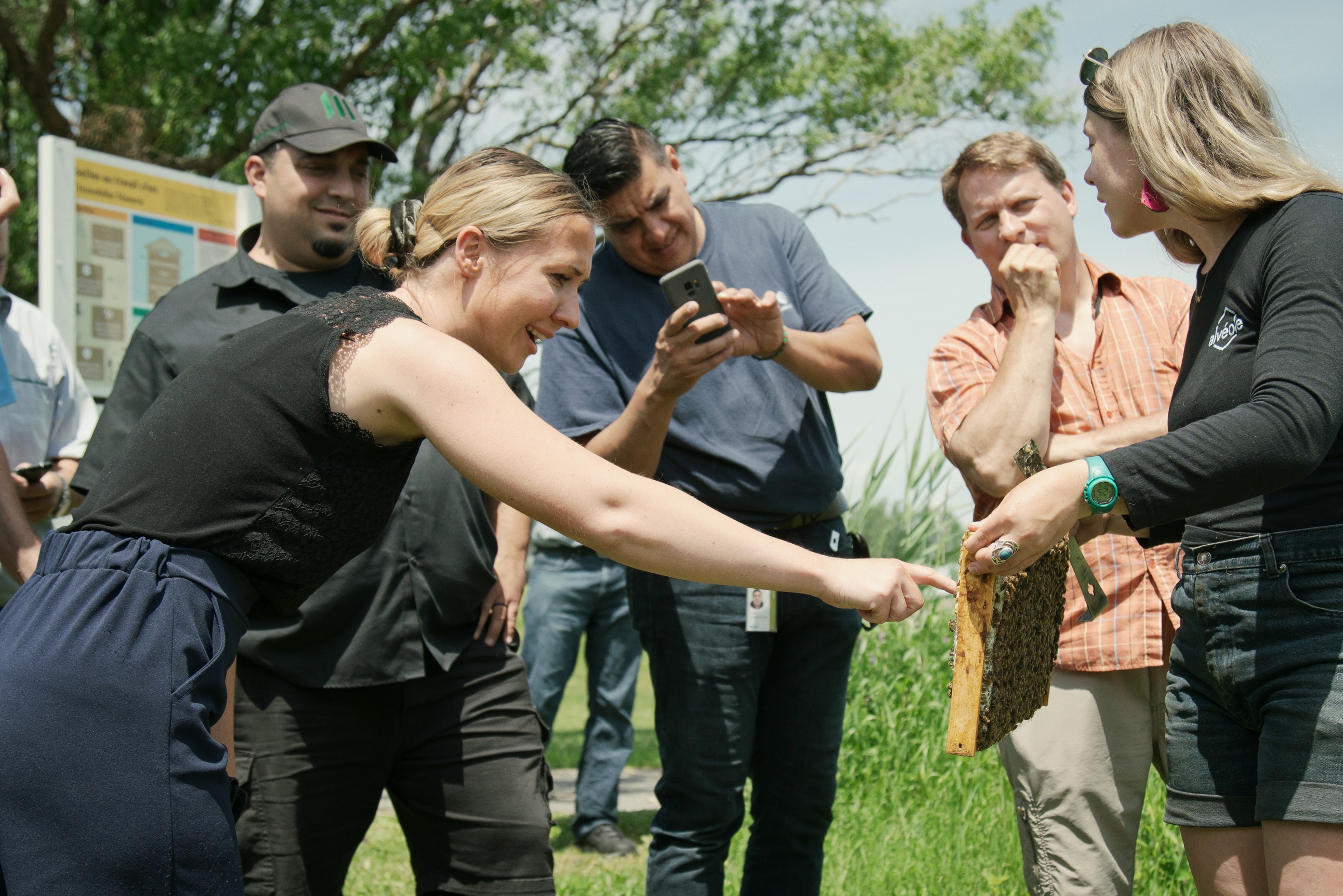
Hives are placed on rooftops or in screened-off sections, managed exclusively by professionals. Most tenants never encounter bees directly. Clear signage and proactive tenant communication are part of the standard program. Building staff does not manage any of this.
What tenants see are the programs, the honey, and the educational events, not the bees.
Cost structure
Nature-based programs are operational line items, not capital expenditures. They cost no more than other tenant engagement events. But they touch multiple budget categories at once: tenant engagement, marketing and leasing collateral, green building certification, and biodiversity reporting.
Compare that to a fitness center (equipment, staff, insurance, replacement cycles) or JBG Smith's $40M lobby renovation at Crystal Drive. Turnkey programs achieve comparable engagement outcomes without comparable capital risk.
Scaling across a portfolio
Start with one or two buildings. Measure engagement, leasing impact, and tenant feedback over two to three quarters. Then expand based on results.
The program is standardized. Same installation model, same educational events, same reporting structure across every building. Property teams do not customize. They do not project-manage. They provide rooftop access. Alvéole's year-round engagement program is designed for exactly this kind of portfolio-scale deployment.
Alvéole operates across 2,200+ commercial buildings in the USA, Canada, and Europe. The deployment model is proven at portfolio scale. CBRE's 2025 survey confirms that occupiers now evaluate landlord performance across entire portfolios, not building by building. A consistent amenity program across your assets signals operational maturity to tenants and investors alike.
The regulatory and market case for acting now
The regulatory landscape has shifted. Biodiversity monitoring as a reportable metric is no longer a voluntary disclosure topic. It is becoming a compliance requirement.
LEED v5, released in 2025, dedicates 25% of its rating system to Ecological Conservation and Restoration. The Biodiverse Habitat credit explicitly encourages pollinator-friendly design and rewards projects that boost green space where pollinators and wildlife can flourish.
GRESB added a new question (RM7) in its 2025 assessment. It requires buildings to report whether they have a biodiversity plan that considers how buildings depend on and affect nature. Institutional investors use GRESB scores to evaluate CRE portfolios.
TNFD published sector-specific guidance for real estate in January 2025. It references the Pollinator Habitat Scorecard as a biodiversity assessment tool and notes that supporting local biodiversity “can improve the organisation's reputation and provide amenity benefit for the real estate assets and occupants.”
PwC states it plainly: “Real estate firms will increasingly be expected to quantify nature-related risks, set science-based targets, and report on progress through recognised frameworks. Early alignment provides a strategic edge.”
The gap between awareness and action is wide. Only 8% of major companies have meaningful biodiversity protection commitments, according to an S&P Global survey, even though the World Economic Forum estimates that 57% of GDP depends on nature. Early movers in biodiversity reporting have a measurable advantage in disclosure quality and investor confidence.
Tenant demand is already there. 73% of people say more greenery near their workplace would improve wellbeing. The market, the regulators, and the tenants are all pointing in the same direction. The question for portfolio operators is not whether to act, but how quickly they can move.
The bottom line for portfolio operators
The next lease is not going to be won by another gym or lobby renovation. It will be won by programs that give a property a story, give tenants a reason to engage, and give asset managers data they can report.
Nature-based amenity programs check every box: low-maintenance, portfolio-scalable, measurable, and certification-ready. The program runs in the background while property teams focus on their core responsibilities.
Ready to see how a nature-based amenity program could fit across your portfolio? Book a demo.
Frequently asked questions
Can an amenity program scale across a portfolio of buildings?
Yes. Programs delivered by a managed partner use a standardized installation and event model. Alvéole operates across 2,200+ buildings in the USA, Canada, and Europe. Asset managers pilot at one property and expand based on measurable results. No per-building customization is required. CBRE's 2025 survey confirms that occupiers now evaluate landlord performance at the portfolio level, making consistent amenity programming a competitive advantage.
What role do amenities play in green building certification?
LEED v5 includes a Biodiverse Habitat credit worth 2 points, rewarding pollinator pathways and wildlife-friendly design. GRESB added biodiversity reporting (question RM7) in 2025. Nature-based programs generate the environmental data that feeds directly into these certification and disclosure workflows. A fitness center or conference room does not produce reportable biodiversity metrics.
How do nature-based amenities compare to traditional amenities for tenant engagement?
Nature-based programs report 20-30% event participation rates compared to 5-15% for standard corporate events. They also produce organic social media content and ready-to-use leasing collateral that traditional amenities like gyms and lounges do not generate. At Nuveen's 730 Third Avenue, building-wide engagement reached 30-40%.
What is the biggest mistake property managers make when adding amenities?
Installing spaces without evaluating the operational burden. A fitness center requires dedicated staff, equipment maintenance, and insurance. A food program requires daily vendor coordination. A managed amenity program requires zero building staff. The right question is not “What amenity should I add?” but “What program can I scale across my portfolio without adding headcount?”