

Do bee hotels help biodiversity
Key takeaways
- Bee hotels can help biodiversity, but only for cavity-nesting native bees and only when well designed and maintained.
- Only about 30% of solitary bee species nest in cavities. Roughly 70% nest in the ground, so a hotel alone never supports all bees.
- Poorly built or unmaintained hotels can spread disease and favor introduced species, which harms native bees.
- At building and portfolio scale, a managed, monitored habitat is what turns a bee hotel into measurable biodiversity impact.
Introduction
Bee hotels are everywhere. Garden centers sell them. DIY blogs promote them. Marketing copy calls them an easy way to save the bees.
But do bee hotels help biodiversity? The honest answer is a qualified yes. They help specific native bees when done right. They can backfire when done wrong.
This article covers what a bee hotel actually is, what the peer-reviewed evidence says, how to build one that helps instead of harms, and what all of this means for property managers and asset managers who need a pollinator program that works at building scale.
What a bee hotel is, and which bees actually use it
A bee hotel is a structure of hollow tubes or drilled blocks. It gives cavity-nesting solitary bees a place to lay eggs and raise offspring. Think of it as nesting habitat, not a hive.
About 90% of North America's roughly 3,600 native bee species are solitary. They do not live in colonies. Of those solitary species, only about 30% nest in existing cavities or tunnels. The remaining 70% nest in the ground.
Only cavity-nesters use bee hotels. The most common residents are mason bees (Osmia species) and leafcutter bees (Megachile species). Honey bees do not use them. Bumble bees do not use them. Most native bees do not use them.
This is why a bee hotel is one tool, not a fix for all pollinators. It supports a specific subset of native bees. It does nothing for ground-nesters, which make up the majority of solitary species.
So, do bee hotels help biodiversity?
Yes, for cavity-nesting native bees. But only when the hotel is well designed, well placed, and actively maintained.
The bees that use hotels are effective pollinators. Mason bees pollinate roughly 95% of the flowers they visit. A single well-managed hotel can provide meaningful nesting habitat for these species on a property that otherwise offers none.
The strongest counter-evidence comes from a peer-reviewed study published in PLOS ONE in 2015. Researchers surveyed about 600 bee hotels in Toronto over three years. They recorded more than 27,000 bees and wasps. The findings were sobering. Introduced bees made up nearly half of all bees recorded. Native wasps occupied about 75% of the hotels each year. Native bees were significantly more parasitized than introduced species.
The researchers did not conclude that bee hotels should be abandoned. They concluded that bee hotels need better design and better management. Unmanaged hotels can act as population sinks for native bees. Managed hotels can act as genuine habitat.
When bee hotels harm native bees
A poorly built or neglected bee hotel can do more harm than good. Property managers need to know the failure modes.
Without annual cleaning, parasitic mites and chalkbrood fungus accumulate in the nesting tubes. These spread from cell to cell and year to year. What started as habitat becomes a disease reservoir.
Mass-produced hotels often use plastic or glass tubes. These trap moisture and cause mold. Many have tunnels that are too short or diameters that are uniform. Some decorative "bug hotels" include pinecones, moss, and bark. These materials are not used by cavity-nesting bees and can attract pests.
One large, densely packed hotel concentrates parasites and pathogens more than natural, scattered nesting would. This is the opposite of what native bees encounter in the wild.
Poorly managed hotels can also favor introduced bees and wasps over natives. If a hotel is installed and forgotten, the species best adapted to colonize it quickly will dominate. Those are often not the native bees the hotel was meant to support.
How to build a bee hotel that actually helps
The evidence points to a clear standard. A bee hotel that helps native bees meets these criteria.
Varied tunnel sizes. Use diameters from about 2 mm to 13 mm (roughly 5/64 inch to 1/2 inch). Different bee species have different body sizes. A range of hole sizes attracts a range of species.
Adequate depth. Tunnels should be 3 to 6 inches deep. Entrances smaller than 1/4 inch need depths of 3 to 4 inches. Entrances 1/4 inch and larger need 5 to 6 inches. Mason bees prefer 1/4 to 3/8 inch entrances in tunnels 5 to 6 inches deep.
Natural, breathable materials. Use wood, reeds, and hollow stems. Do not use plastic, glass, pinecones, or moss. Breathable materials prevent moisture buildup and mold.
Smaller and scattered. Keep each hotel under about 100 tunnels. Place several small hotels rather than one large one. This mimics natural nesting and reduces disease concentration.
Proper placement. Mount hotels a few feet off the ground, facing southeast to catch morning sun. Place them near flowering plants and a mud source. Mason bees use mud to seal their nest cells.
Annual maintenance. Replace or clean nesting tubes every year after the bees emerge. This is the single most important action. It prevents parasite and disease buildup.
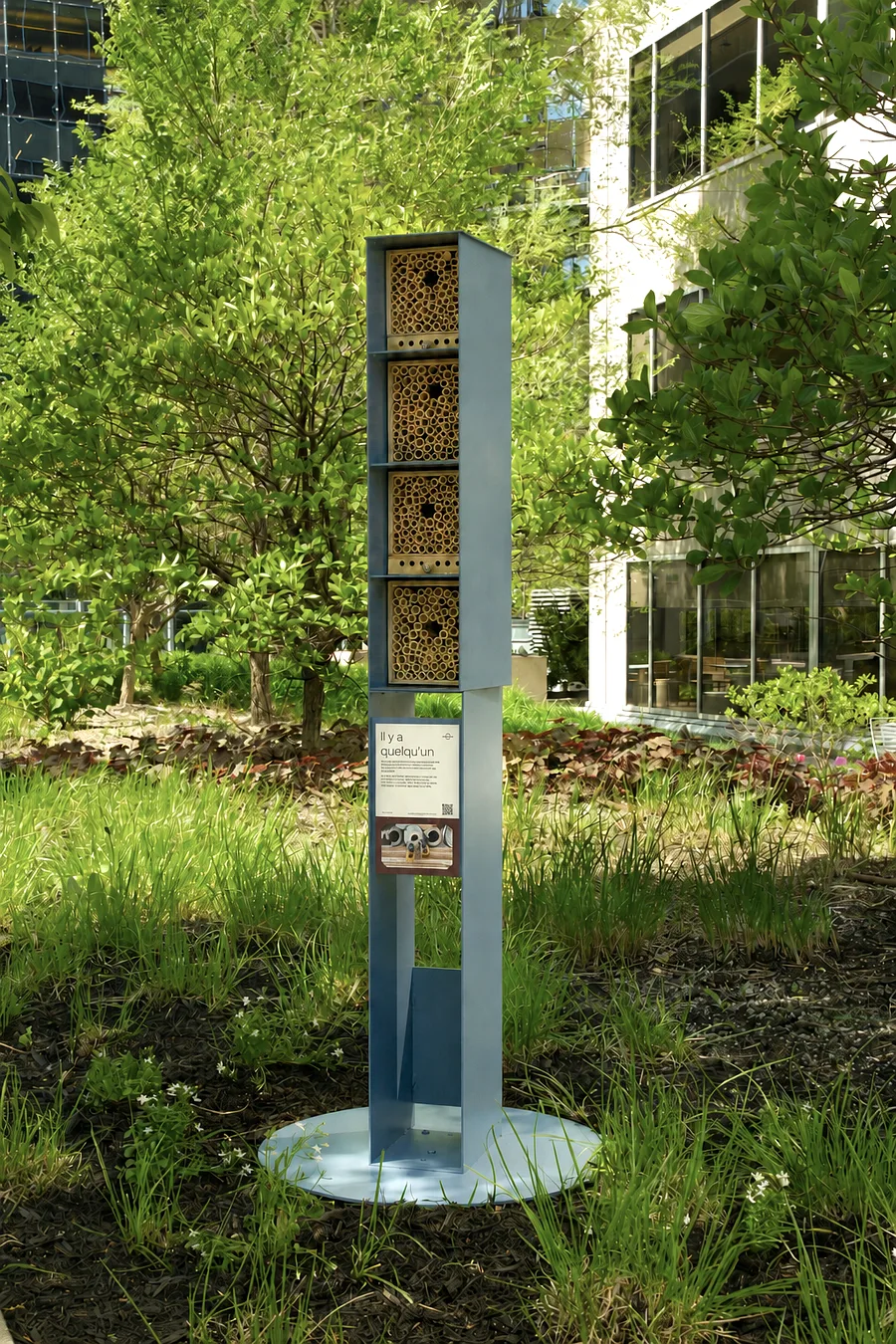
Alvéole's redesigned Wild BeeHome is engineered to meet this standard. It is a purpose-built habitat for wild solitary pollinators, now running across more than 500 buildings.
What this means for commercial properties
The single biggest failure point for bee hotels is missed maintenance. A hotel installed and forgotten will underperform at best. At worst, it will harm the native bees it was meant to support.
This is exactly what a managed service removes.
For property managers and asset managers, the question is not whether a bee hotel can help biodiversity. The question is whether your organization can maintain it correctly, year after year, across every building in your portfolio. A DIY box on a rooftop is not a biodiversity program. A managed, monitored habitat is.
A whole-site approach pairs nesting habitat with forage plantings. It addresses ground-nesting bees, not just cavity-nesters. It treats pollinator support as part of a building's nature strategy, not a one-time installation.
Alvéole's Wild BeeHome gives property teams a repeatable, low-lift program. The habitat is designed to the evidence-based standard. Maintenance is handled. Asset managers get a program that scales across a portfolio without adding operational burden.
Turning habitat into biodiversity data you can report
Habitat only counts if you can measure it. A bee hotel on a rooftop does not generate the data that disclosure frameworks require.
Alvéole's Nature Sensor uses bioacoustic monitoring and eDNA analysis to capture on-site biodiversity activity. It identifies species and tracks changes over time. The Aura platform turns that monitoring into portfolio-level nature data that property and asset managers can actually use.
This connects directly to reporting. GRESB added a nature and biodiversity indicator to its 2025 Real Estate Assessment. The indicator is exploratory and unscored in 2025, but it signals where real estate reporting is headed. The framework aligns with TNFD, the leading voluntary standard for nature-related disclosure.
For asset managers, this closes the gap between a nature commitment and verifiable, asset-level data. A biodiversity initiative that cannot be measured is a liability in an LP meeting. A biodiversity initiative backed by sensor data and platform reporting is an asset.
Frequently asked questions
Are bee hotels good for bees?
They can be. A well-designed and maintained bee hotel provides nesting habitat for cavity-nesting native bees like mason bees and leafcutter bees. A poorly built or neglected hotel can spread disease and favor introduced species over natives.
Do bee hotels attract the wrong species?
They can. A three-year study of Toronto bee hotels found native wasps occupied about 75% of hotels, and introduced bees made up nearly half of all bees recorded. Proper design and annual maintenance shift the balance toward native species.
How often should you clean a bee hotel?
Every year. Replace or clean nesting tubes after the bees emerge in spring. Annual cleaning prevents parasitic mites and chalkbrood fungus from building up and spreading between generations.
Where is the best place to put a bee hotel?
Mount it a few feet off the ground, facing southeast for morning sun. Place it near flowering plants that provide forage and near a mud source. Mason bees use mud to seal their nest cells.
Do bee hotels help all bees?
No. Only cavity-nesting solitary bees use hotels. That is about 30% of solitary bee species. The other 70% nest in the ground. A bee hotel is one tool, not a complete pollinator strategy.
The bottom line
A bee hotel helps biodiversity when it is well designed, well placed, and maintained. Otherwise, it can do more harm than good.
At building and portfolio scale, a managed, monitored habitat is what makes the difference. It removes the maintenance failure point. It generates the data that reporting frameworks require. It turns a nature commitment into a verifiable, asset-level program.
If you are a property manager or asset manager looking to add pollinator habitat that actually works, Alvéole can help.

.png)
.jpg)