
4 levers you can use to differentiate your portfolio

The office market has not softened evenly. It has split.
Prime buildings closed Q3 2025 at 14.2% vacancy. Non-prime sat at 19.1%. That 4.9-point spread is widening every quarter, driven by tenants upgrading rather than adding space. Nationally, 60% of office occupiers are currently considering a move to higher-quality space.
This is not a demand problem. It is a differentiation problem.
The buildings on the right side of that gap made deliberate choices about how to position themselves before the rollover window arrived. They did not wait for tenants to signal dissatisfaction. They built programs that gave tenants a concrete, recurring reason to stay.
Differentiation programs that prevent vacancy are not amenity budgets. They are vacancy insurance.
The cost of getting this wrong is not abstract. A single 10,000 sq ft floor sitting empty typically generates between $810,000 and $1,500,000 in carrying costs.
The prime vs. non-prime performance gap is near a record high, and the urgency to act is not easing.
Vacancy cost componentOne tenant, 10,000 sq ftLost base rent (12 months)$250,000–$400,000Tenant improvement allowance$500,000–$1,000,000Free rent period$20,000–$40,000+Leasing commissions$40,000–$80,000Total estimated carrying cost$810,000–$1,500,000+Sources: TI allowances $73–$92 per sq ft by asset tier, CBRE Research Q4 2024. Free rent period averaged 9.0 months across 3,900 lease transactions, CBRE H1 2024. Leasing commissions 4%–6% of total lease value, 2025 benchmarks. Base rent $25–$40 NNN per sq ft, Class A/B urban office.
The buildings winning renewals in 2026 and 2027 made deliberate program choices 12 to 18 months earlier. Trophy supply is tightening and the window for Class B and B+ buildings to close the experience gap is narrowing with it.
There are four levers available to asset managers. None require a capital commitment. All can be tested at the asset level before a portfolio-wide decision.
Lever 1: Physical programming
Physical programming covers the on-site installations that give a building a distinct identity.
77% of New York City leasing activity in 2024 occurred in buildings with at least one amenity. Building quality and location drive 40% of office leasing decisions, ahead of cost and rightsizing combined.
Not all programs pull their weight. The ones that do share three traits:
- They create a recurring reason to be in the building, not a single occasion.
- They run without ongoing PM coordination after setup.
- They give brokers a specific, ownable talking point no competitor building in the submarket can replicate.
Most programs fail at least two of those criteria.
A rooftop reception requires full vendor coordination, generates no data, and produces no follow-up touchpoint. A fitness class program shows low participation rates and cannot be attributed to renewal decisions.
One-off events generate goodwill. Recurring programs generate data.
Case study: 2000 Market Street, Philadelphia, PA
Class A, 29-story | Nahla Capital / FCA
Program: Vacant tenant space converted into a 5,000 sq ft shared conference hub on the 6th floor, plus a fitness center with an outdoor pickleball court.

Outcome: Booked solid month-to-month. Used as a retention and new-leasing tool across all tenants. The space generates a recurring reason to be in the building that floor plans alone cannot produce.
Case study: 757 Third Avenue, New York, NY
Class A | JLL
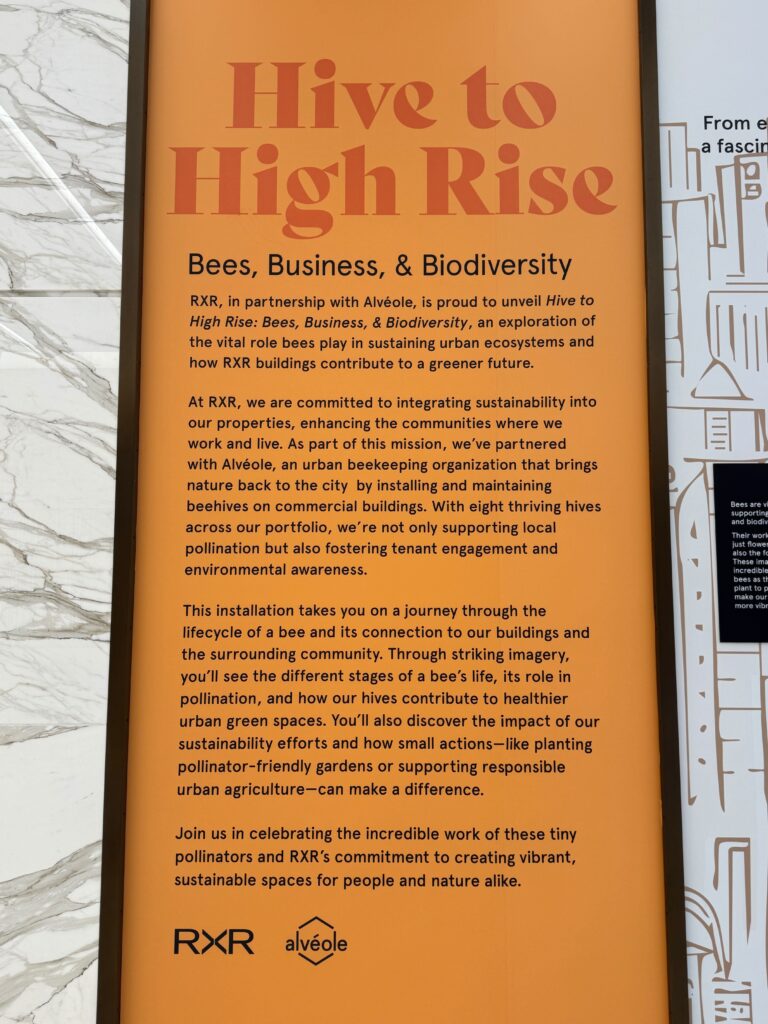
Program: Rooftop beehive and two wild bee habitats installed as part of a sustainability and tenant engagement strategy. Quarterly workshops, branded honey, and biodiversity data feeding into GRESB investor reports.

Outcome: BOMA New York Pinnacle Earth Building of the Year 2024. One program that meets all three criteria and produces a sustainability data output. Environmental data feeds directly into investor packages. Brokers have a specific, visual, ownable talking point no competitor building in the submarket can claim.
Lever 2: Tenant engagement
Most asset managers enter renewal conversations after a tenant has already begun evaluating alternatives. The formal notice period is not the start of the decision. It is the end of it.
Buildings that protect occupancy enter the renewal window 12 to 18 months earlier because they have been generating engagement data throughout. That predictive window is the competitive advantage.
A 2024 peer-reviewed study by Hu, Kok, and Palacios at MIT and Maastricht University analyzed 2,965 U.S. office buildings and found that each one-point improvement in tenant satisfaction produces:
- 8.36% higher likelihood of renewal
- 11.52% higher likelihood of recommending the building to another firm
- 15.80% lower probability of vacating
Satisfaction is measurable and it predicts behavior. The question is whether the building is generating data to see it coming.
One-off events produce goodwill but no signal. Recurring programs produce data an asset manager can act on before the renewal conversation begins.

The distinction between programs is not cost. A charity volunteer day and a quarterly beehive workshop can cost similar amounts. The difference is what each produces.
The volunteer day generates a single goodwill moment with no follow-up touchpoint, no attendance record, and no signal about tenant sentiment. The quarterly program generates attendance data, participation trends, and a recurring reason for the property team to reach out.
Case study: Bulfinch Portfolio, Needham, MA
Three suburban Class A assets, approximately 400,000 sq ft
Program: HqO deployed across three buildings to connect tenants with food vendors, fitness classes, and building communications, with engagement data used to identify and cut underperforming programs.
Outcome: Shifted amenity investment from guesswork to data-driven decisions. The engagement platform produced the tracking layer that allowed the asset manager to act on what tenants were actually using.
Lever 3: Certifications and sustainability disclosure
Corporate tenants now carry their own sustainability reporting requirements. The building they occupy is part of that reporting.
79% of corporate tenants say green building certifications affect their real estate decisions.
LEED-certified buildings command a 4 to 8% rent premium over non-certified peers. JLL estimates that 30% of global demand for low-carbon space will go unmet in 2025.
Certification logos on a leasing brochure are table stakes.
The buildings that use certifications as a differentiation lever generate ongoing, program-level data that tenants can pull into their own disclosure reports.
A tenant who relies on the building's environmental data for their own compliance reporting has a structural reason to stay that no competing building can immediately replicate.
Certification sequencing
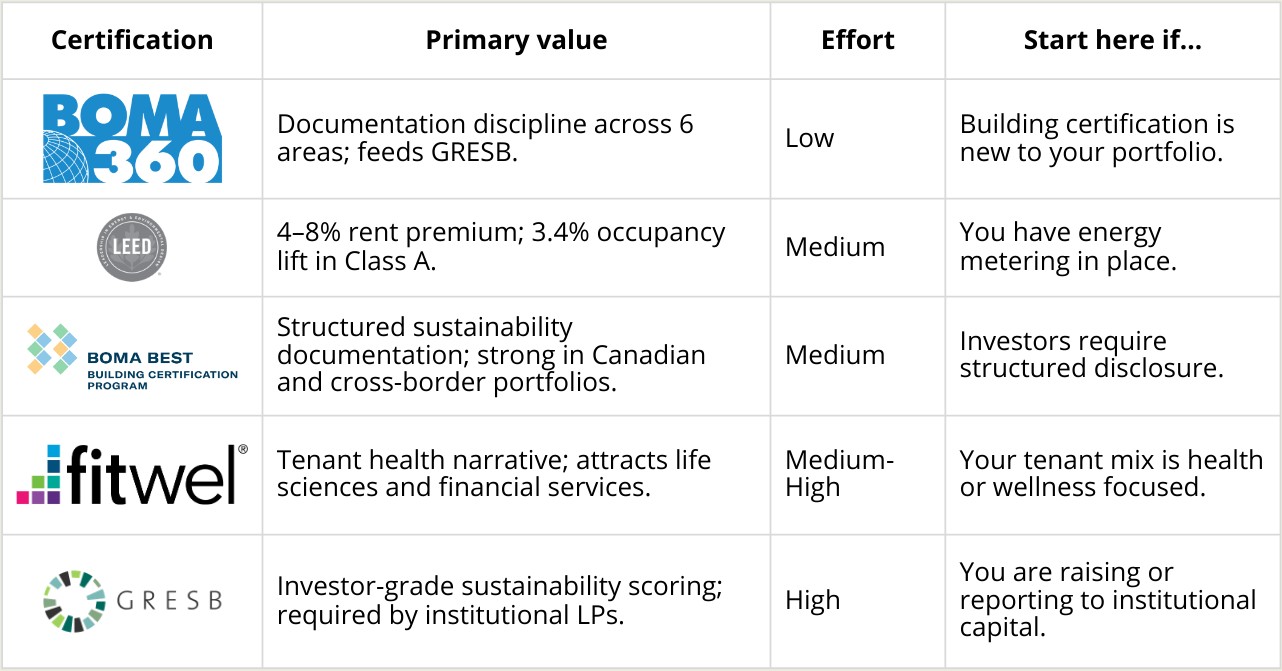
Not all certifications serve the same purpose. The sequencing matters.
- BOMA first. It establishes operational efficiency as a baseline and positions the building for the next tier.
- LEED or WELL next. These create the tenant-facing positioning: healthier spaces, lower environmental footprint, verifiable standards a corporate tenant can reference in their own reporting.
- GRESB for investor-level disclosure. GRESB aggregates property-level data into portfolio-level scores that institutional investors use to evaluate fund performance.
Each layer builds on the one before it.
On-site programs fill the gap between certification cycles: biodiversity counts, urban greening metrics, tenant participation records, and quarterly environmental reports are the kind of continuous data certification frameworks can absorb.
Case study: BGO MEPT Fund, U.S. multi-market
Institutional core open-end fund by BGO
Program: MEPT has maintained industry-leading environmental sustainability standards across its diversified portfolio, achieving a top-tier GRESB ranking for 15 consecutive years.
Outcome: Institutional LPs cite GRESB performance as a factor in capital commitments. The fund's sustainability track record supports both asset-level retention and investor-level reporting in a single documented framework.
Lever 4: Marketability
Physical programs build the stage. Tenant engagement fills it. Certifications document it. Marketability makes all of it visible to the people who decide where your next tenant signs.
Prime buildings are 8% of U.S. office inventory but captured 12% of leasing volume since 2021.
Tenants in prime buildings sign leases averaging 107 months, versus 86 months in non-prime. Those buildings give brokers a story, not just a floor plan.
A differentiated broker package has three components:
- One sentence a broker can say on tour that no competitor building in the submarket can claim.
- One visual anchor that makes a prospect remember the building a week after the tour.
- One plain-language sustainability summary tied to the tenant's own disclosure requirements, not just a certification logo.
Most buildings provide none of these.
Case study: 31 Penn Plaza, New York, NY
Class A | Vanbarton Group / TPG Architecture
Program: A single 6th-floor space with antique mirror glass, stone tables, and dimmable lighting. Small footprint, designed to be iconic rather than large.

Outcome: Brokers reference it as a signature feature on every tour, differentiating the building against larger Class A inventory in the same submarket. The space is the one-sentence talking point no competitor can replicate.
Case study: 1750 H Street NW, Washington
Class B repositioning | GTM Architects
Program: Rooftop terrace expanded with a telescoping glass wall that opens the conference room directly onto an outdoor lounge.

Outcome: In a submarket where most Class B has no outdoor access, the terrace became the building's opening leasing visual and its consistent broker talking point. The physical program and the marketing asset are the same thing.
Marketability is not a branding exercise. It is the last mile of a differentiation strategy. The programs, data, and certifications from the first three levers only differentiate a building if the people making leasing decisions know about them.
Putting it together: a three-step action plan
The four levers are a sequence, not a simultaneous deployment. Most asset managers have capacity to act on one lever at a time.

Phase 1: Start with your highest-risk asset
Not the most visible asset. Not the newest. The asset where a single vacancy changes the year.
Identify one program that meets the three criteria: recurring, zero PM burden after setup, and a broker talking point. Deploy it. Measure attendance and participation over two to three program cycles.
Phase 2: Scale what works
If the program produces renewal-protective data and a broker talking point, it scales.
Portfolio-wide deployment removes the coordination variable and creates consistency in investor reporting.
An asset manager running the same program across eight buildings has eight data sets feeding a single disclosure package. Institutional investors and corporate tenants see consistency as a signal of management quality.
Phase 3: Amplify the visibility
Update the broker package. Add data outputs to investor decks. Add the program to leasing materials.
The program built in Step 1 becomes the story brokers tell in Step 3. The certification data from Step 2 becomes the sustainability summary that speaks to corporate tenants' disclosure requirements.
The buildings that differentiate on purpose give tenants a concrete reason to stay. Concrete reasons show up in renewal rates before they show up in vacancy reports.
How Alvéole fits
Alvéole installs and manages urban beehives and pollinator habitats as tenant engagement programs for commercial real estate portfolios.
The program produces quarterly touchpoints, runs without PM involvement after installation, and generates reporting outputs for investor and sustainability disclosure packages.
If you are managing an asset with rollover in the next 18 to 36 months, a demo takes 30 minutes. It covers what deployment looks like for a specific building, what the quarterly reporting outputs include, and what the program costs relative to one month of vacancy.
Book an intro call to see how it fits your portfolio.